Contents
- Offer letter vs appointment letter vs joining letter at a glance
- What is an offer letter?
- What does an offer letter include?
- Does an offer letter mean you are hired?
- Is CTC mentioned in an offer letter?
- What is an appointment letter?
- What does an appointment letter include?
- Is an appointment letter mandatory in India?
- Is salary mentioned in an appointment letter?
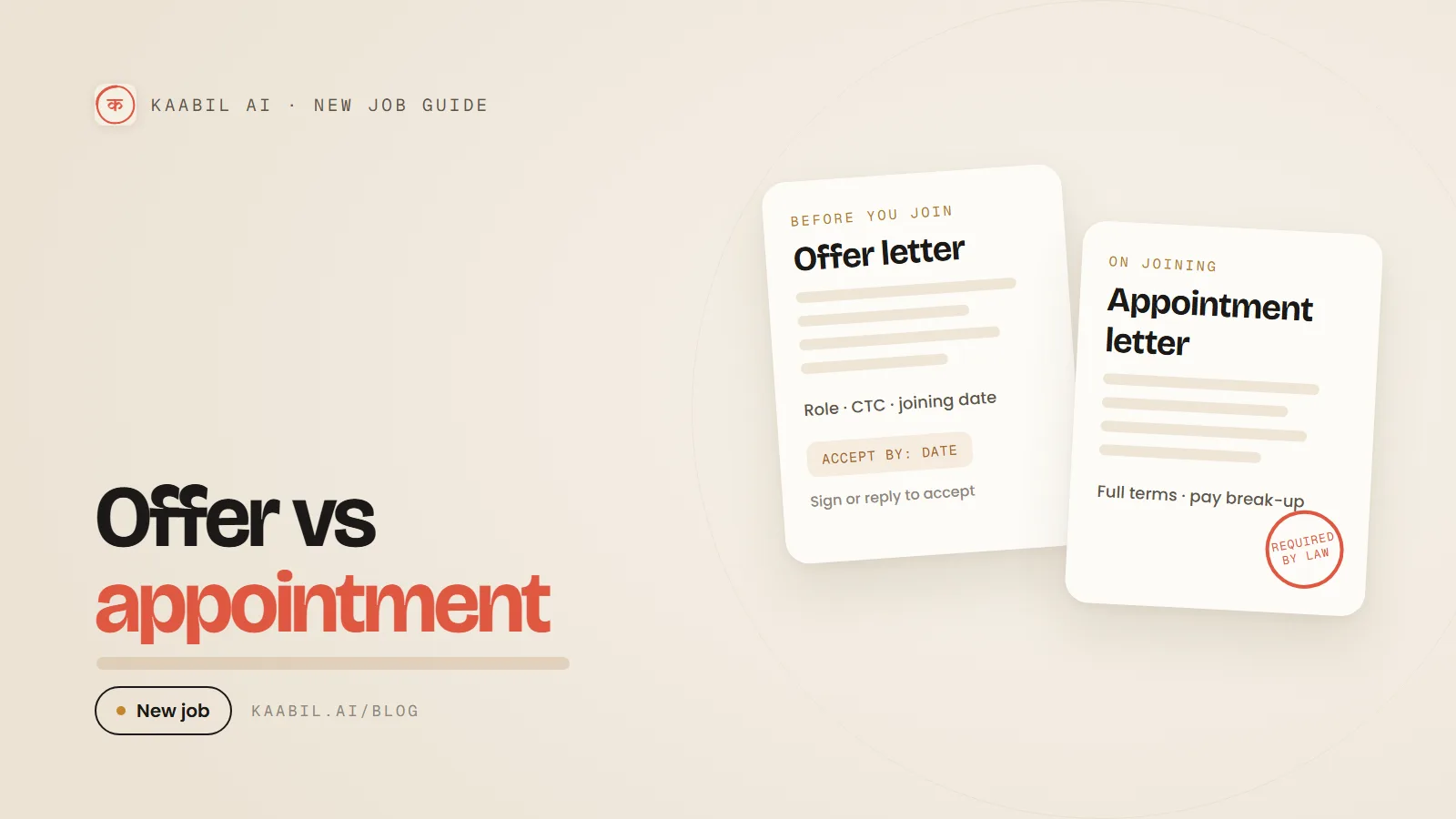
- What is the difference between an offer letter and an appointment letter?
- Are an offer letter and an appointment letter the same?
- Is a letter of intent the same as an offer letter?
- What is a joining letter?
- Which comes first, the offer letter or the appointment letter?
- What should you check before you sign?
- Can you reject an offer letter?
- Can a firm withdraw an offer letter?
- How can you spot a fake offer or appointment letter?
- How do you download your appointment letter?
- Frequently asked questions
You cleared the interview. Then an email lands with a PDF called "Offer Letter". On your first day, HR hands you a second one called "Appointment Letter". Are they the same? Which one matters more?
This guide answers that from your side of the table. It explains what an offer letter is and what an appointment letter is. It shows how the two differ, where a joining letter fits, and which comes first. It also lists what to check before you sign, so the pay, probation and notice period on paper match what you were told.
There is a legal side too. India's four labour codes replaced 29 older labour laws on 21 November 2025. One of them, the OSH Code, says covered firms must give each employee an appointment letter. Fake offers are a real risk as well: in an Indeed survey reported in July 2026, 93% of Indian employees and job seekers said they had come across suspicious or fraudulent job offers.
In short, the offer letter is the offer. The appointment letter confirms the job and its full terms.
Offer letter vs appointment letter vs joining letter at a glance#
Point | Offer letter | Appointment letter | Joining letter |
|---|---|---|---|
Who writes it | The firm | The firm | Often you |
When | After selection, before you join | On or after joining | On your first day |
Purpose | Offers you the job | Confirms the job and its terms | Says you have joined |
Pay details | CTC, with a short break-up | Full pay break-up and benefits | None |
Needed by law? | No set rule in the labour codes | Yes, for firms under the OSH Code | No |
What you do | Accept, ask for changes or say no | Read, sign and keep a copy | Give it to HR |
What is an offer letter?#
An offer letter is a firm's written job offer. It comes after you are selected and before you join. It names the role, the pay and the joining date, and it often sets a date by which you must accept. Many offers also come with a few checks.
Think of it as the pitch. It tells you what the firm is ready to give, so you can decide, ask for changes or compare it with other offers. Many firms send it by email as a PDF. They ask you to sign and return it, or reply to say yes.
The offer is not your contract for life. It is the first step. The full terms often come later, in the appointment letter.
What does an offer letter include?#
An offer letter covers the role, the pay and the main terms of the offer. The exact list changes from one firm to the next, so read each line with care. Many offer letters include these points.
- Job title, team and work location
- Your CTC, often with a short pay break-up
- Your date of joining and the last date to accept
- Probation and notice period, sometimes in brief
- Checks such as a background check (BGV) or your final marks
- An HR contact and how to accept
Does an offer letter mean you are hired?#
Not fully. An offer letter means the firm wants you, but many offers are conditional. You are hired once you accept, clear the checks and join on the agreed date. Until then, keep your options open.
This matters most if you already have a job. Do not resign until you hold the offer in writing and have accepted it. If the letter says it depends on a background check or papers, ask HR what they need and by when.
Is CTC mentioned in an offer letter?#
Often, yes. Offer letters often state your yearly CTC, and many add a short break-up of basic pay, allowances and the firm's PF share. CTC is not what you take home. PF comes out first, and so do professional tax and income tax where they apply.
So a 10 LPA offer does not mean ₹83,333 in your bank each month. To see what reaches your account, read our LPA full form guide or the 10 LPA in-hand salary example.
What is an appointment letter?#
An appointment letter is the formal letter that confirms your job and sets out its terms. The firm gives it once you accept the offer or join. It is the letter to keep as proof that you worked there.
If the offer letter is the pitch, the appointment letter is the record of the deal. It lists your title, the date you started, your pay, probation, notice period, work hours and leave. It often adds rules on transfers, secrecy and conduct.
You will need it again. Background checks at your next job often ask for your appointment letter, along with your payslips and your relieving letter.
What does an appointment letter include?#
An appointment letter spells out the full terms of your job, in more detail than the offer letter. Read it slowly, because once you sign it, these terms apply to you. Many appointment letters cover the points below.
- Job title, date of joining and place of work
- Full pay break-up and benefits
- How long probation lasts and how confirmation works
- Notice period, work hours and leave
- Rules on transfers, secrecy and conduct
- Any bond, service agreement or non-compete clause
Is an appointment letter mandatory in India?#
Yes, for firms covered by the OSH Code, 2020. Section 6 of the Code says every such employer must give each employee a letter of appointment. The letter must carry the details, and follow the format, that the government sets.
The Code covers "establishments". In simple terms, that means places with ten or more workers. The limit does not apply to hazardous or life-threatening work that the Central Government notifies. The Code also said that staff with no appointment letter when it came into force had to get one within three months.
These rules arrived with the four labour codes, which took effect on 21 November 2025. The codes brought 29 older labour laws into four.
Is salary mentioned in an appointment letter?#
Yes, often in full. An appointment letter often gives your whole pay break-up: basic pay, allowances, the firm's PF share and other benefits. It should match your offer letter. If it does not, ask HR in writing before you sign.
Keep both letters side by side when you check. Look at the yearly CTC, the fixed pay and any variable pay. Small changes in basic pay can change your PF and your gratuity later.
What is the difference between an offer letter and an appointment letter?#
The main difference is timing and purpose. The offer letter comes first and offers you the job. The appointment letter comes on or after joining and confirms the job with its full terms. Only the appointment letter is a legal must for covered firms.
Point | Offer letter | Appointment letter |
|---|---|---|
When | After selection, before joining | On or after joining |
Purpose | Makes the offer | Confirms the job |
Detail | Key terms: role, CTC, joining date | Full terms: pay, probation, notice, leave |
Legal status | No set labour-code rule | Required under the OSH Code |
Can it change? | Yes, before you accept | It should match what you accepted |
How long to keep it | Until the appointment letter comes | For your whole career |
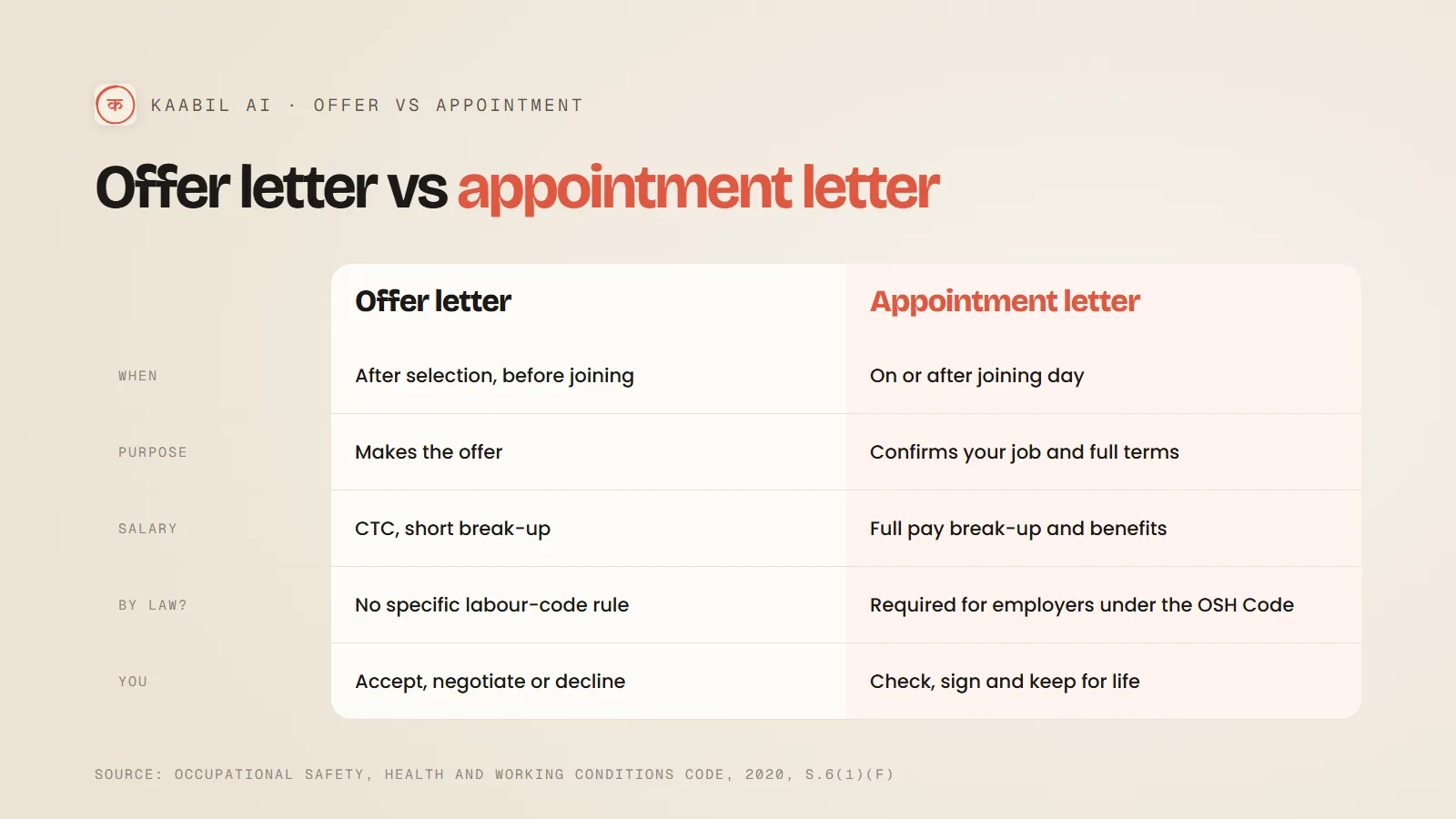
The two letters work as a pair. The first one gets you to say yes. The second one puts the deal on record.
Are an offer letter and an appointment letter the same?#
No, but some firms merge them into one "offer-cum-appointment letter". In that case, one letter carries both the offer and the full terms. Read it as carefully as you would an appointment letter, because signing it locks in those terms.
Names also vary from firm to firm. Some call the first letter a "provisional offer". Some call the second one a "letter of employment". Go by what the letter does, not by its name.
Is a letter of intent the same as an offer letter?#
Not quite. A letter of intent (LOI) shows that a firm plans to hire you, often before the final offer is ready. An offer letter is the formal offer with the terms written out. If you get an LOI, ask HR when the formal offer will follow.
What is a joining letter?#
A joining letter is a short letter that says you reported for work on a set date. You often write it yourself, on a format HR gives you on day one. Some firms also use the name for a letter they issue on joining day.
So, are a joining letter and an appointment letter the same? Not usually. The joining letter records that you joined. The appointment letter records the terms on which you were hired. If your firm calls its letter a "joining letter", check whether it lists your full terms.
Which comes first, the offer letter or the appointment letter?#
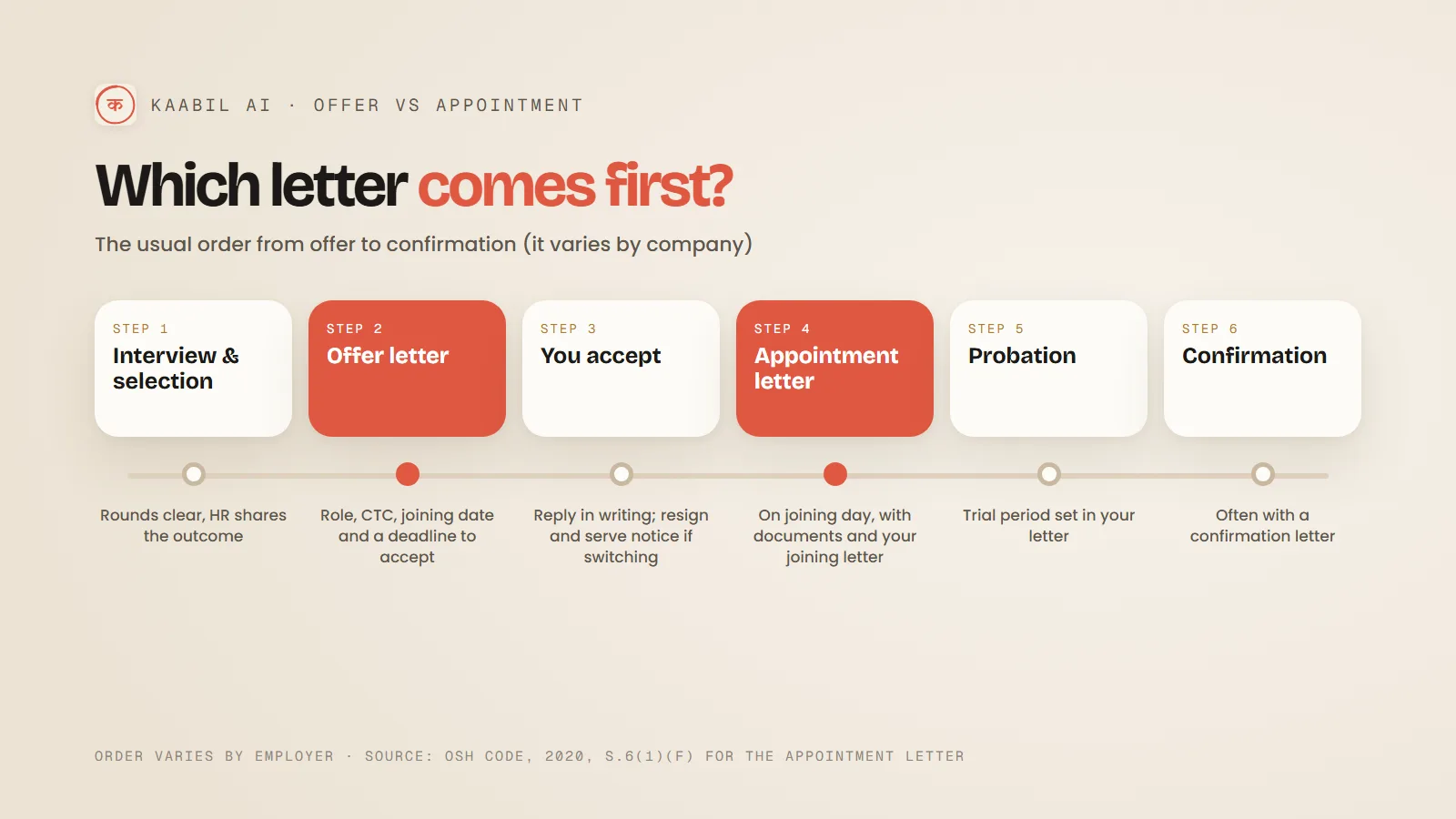
The offer letter comes first. You get it after selection and accept it. The appointment letter follows on or after your first day. Some firms send it before you join, and some only after your background check is clear, so the order can vary.
Here is the usual path for a fresher or someone switching jobs:
- Interviews and selection
- Offer letter, with a date to accept
- You accept in writing
- If you have a job, you resign and serve your notice (see notice period meaning)
- First day: papers, joining letter and appointment letter
- Probation, then confirmation (see probation period meaning)
What should you check before you sign?#
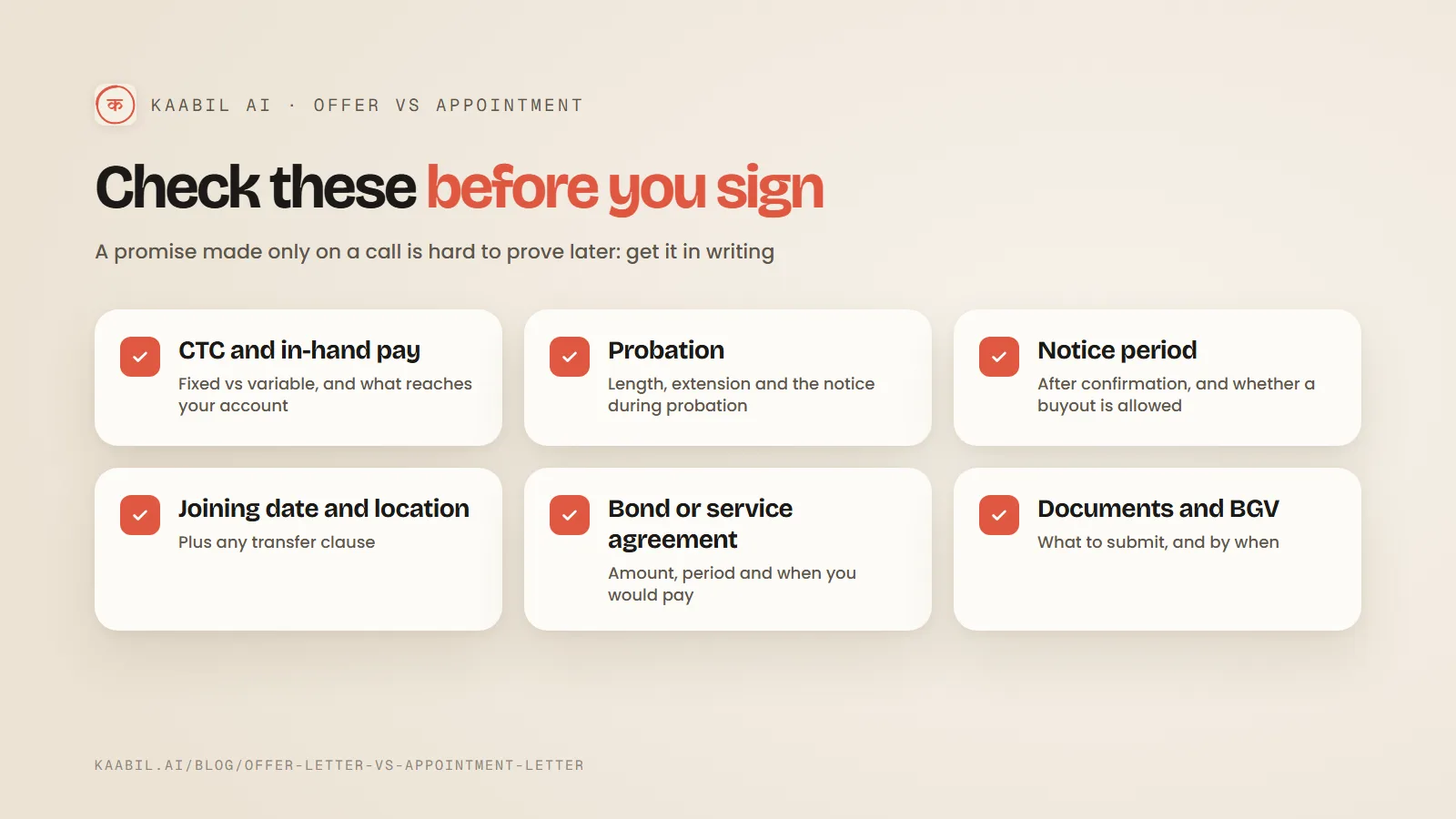
Before you sign either letter, check that the money, the time you commit and the terms match what you were told. A promise made only on a call is hard to prove later. Ask HR to fix the letter or to confirm the change by email.
This step saves a lot of trouble. A bond, a long notice period or a lower pay figure is easy to miss. These are the points to check.
- CTC and in-hand pay: what is fixed, what is variable, and what you get each month
- Probation: how long it lasts, if it can be extended, and the notice during probation
- Notice period: after confirmation, and if a buyout is allowed
- Joining date and location: and any transfer clause
- Bond or service agreement: the amount, the period and when you would pay
- Non-compete and secrecy: how wide they are and for how long
- Papers and BGV: what to submit and by when (see BGV full form)
- Benefits: PF, insurance, leave and gratuity (see gratuity for how it is worked out)
Can you reject an offer letter?#
Yes. You can turn down an offer letter, best with a short, polite email before the last date to accept. If you have already signed, check the letter for a notice period or bond first. If a large bond is involved, get advice before you decide.
Saying no politely keeps the door open. Thank the firm, give a one-line reason if you like, and leave it there.
Can a firm withdraw an offer letter?#
It can happen, for example when plans change or a background check fails. So protect yourself early. Keep each email and message about the offer. Do not resign from your current job until your offer is firm and accepted in writing.
How can you spot a fake offer or appointment letter?#
Genuine firms do not ask you to pay to get a job. Be wary of any letter that asks for a "security deposit", a training fee or a sign-up fee. Fake letters also tend to come from free email IDs and arrive without a real interview.
The risk is not small. Indeed surveyed Indian employees and job seekers, and Business Today reported the results in July 2026. 93% of employees and job seekers said they had come across suspicious or fraudulent job offers. 51% said they were not sure they could tell a real recruiter from a scammer.
Watch for spelling errors and a rush to accept within hours. A salary far above the market is a warning sign. So is a letter with no named HR person. Check the firm's official website and careers page. Call the firm on a number you find yourself, and never share bank details or OTPs before you join.
How do you download your appointment letter?#
Many firms email the appointment letter or put it on an HR portal. There, you can download it as a PDF from your profile or files page. If you cannot find it, ask HR in writing, since covered firms must issue one.
Keep a folder for your job papers. It should hold your offer letter, appointment letter, payslips and, later, your relieving letter and experience letter. If you plan to switch, our resignation letter format guide has samples you can use.
To accept an offer in writing, use our offer letter acceptance email samples.
Got an offer and want to see what else is out there before you sign? On the Kaabil App, the Career Agent contacts recruiters for you. It sends only what you approve, so you can compare offers with confidence.
Frequently asked questions
Not fully. An offer letter shows the company wants to hire you. But many offers have conditions, such as a background check and documents. Your job is confirmed once you accept, clear those checks and join. The appointment letter then records your terms.
It means you were selected and offered the job, usually with conditions. You are hired once you accept, meet those conditions and join. Until then, do not resign from your current job unless you hold the offer in writing and have accepted it.
Usually, yes. Offer letters usually state your yearly CTC, often with a short pay break-up. CTC is not your take-home pay. PF is cut before you are paid, and so are professional tax and income tax where they apply.
Yes, usually in full. An appointment letter normally gives your whole pay break-up: basic pay, allowances, the company's PF share and benefits. If any figure differs from your offer letter, ask HR in writing to fix it before you sign. Keep both letters.
Yes, for employers covered by the OSH Code, 2020. Section 6 says they must give each employee a letter of appointment, in the format the government sets. The Code broadly covers places with ten or more workers, and some notified hazardous work with fewer.
Not usually. The company issues the appointment letter, and it sets out the terms of your job. A joining letter is usually written by you on day one, to say you joined. Some firms also use the name for a letter they issue on joining day.
It is one letter that holds both the job offer and the full terms of your job. Some companies use it to save a step. Read it as carefully as an appointment letter. Once you sign it, it records your pay, probation and notice period.
The offer letter comes first, after you are selected. You accept it, and the appointment letter follows on or after your first day. Some companies send it before you join, and some only after your background check, so the order can vary.
Yes. You can turn down an offer letter, best with a short, polite email before the last date to accept. If you have already signed it, check the letter for a notice period or bond first. If a large bond is involved, get advice first.
You accept the offer, send your documents and clear the background check. If you have a job, you resign and serve your notice. On your first day, you finish the paperwork and get your appointment letter. Then your probation period begins.
Many companies email the appointment letter or put it on an HR portal. You can download it as a PDF from your profile or documents page. If you cannot find it, ask HR in writing, since covered employers must issue one.
Genuine firms do not ask you to pay for a job. Be careful if a letter asks for a fee or deposit, or comes from a free email ID. Also watch for no real interview and a push to accept within hours. Check the company's official website.
Sources
- The Occupational Safety, Health and Working Conditions Code, 2020: sections 2 and 6, Ministry of Labour and Employment, Government of India · checked
- Government makes the four Labour Codes effective (press release, 21 Nov 2025), Press Information Bureau, Government of India · checked
- More than 9 in 10 job seekers encounter fake job offers (Indeed report), Business Today (9 Jul 2026) · checked