Contents
- What does notice period mean?
- How long is a notice period in India?
- What is the notice period for a fresher?
- What do common notice period terms mean?
- What is a notice period buyout?
- Worked example: buyout amount and last working day
- Can you leave without serving your notice period?
- How do you write a notice period email?
- Frequently asked questions
“What is your notice period?” is one of the first questions recruiters ask, because the answer decides how soon you can join. Here is what the term means, how it works for freshers and job switchers in India, and what to do if you want to leave sooner.
What does notice period mean?#
A notice period is the time between telling your employer you are leaving and your last working day. During it you keep working, finish or hand over your tasks, and the company plans for your replacement. It usually works the other way too: an employer ending your job gives you notice, or pay in place of it, as your contract sets out. For workers covered by the Industrial Relations Code, 2020, the law also requires at least one month’s notice before a retrenchment.
How long is a notice period in India?#
It depends on your offer or appointment letter and the company’s policy. Many companies set 30, 60 or 90 days, often shorter during probation and longer for senior roles. The number in your own letter is the one that counts.
What is the notice period for a fresher?#
If you have never had a job, your notice period is zero. On job portals and application forms, write “Immediate joiner” or “0 days”. Being able to join quickly can help when a team needs someone soon.
If you are a fresher who has already joined a company, check your appointment letter. Many companies set a shorter notice period during probation than after confirmation, but the length varies from company to company.
What do common notice period terms mean?#
Term | What it means |
|---|---|
Serving notice | Working through your notice period after you resign |
Last working day (LWD) | Your final day at the company, when the notice period ends |
Early release | The company agrees to let you leave before the notice period ends |
Notice period buyout | You, or your new employer, pay for the notice days you don’t serve |
Full and final settlement (F&F) | The last payment after you leave: pending salary and dues, minus any deductions. Under the Code on Wages, 2019, wages due must be paid within two working days of your last day |
Relieving letter | The letter confirming that you have left and been released from your duties |
What is a notice period buyout?#
A notice period buyout means paying your employer for the part of the notice you don’t serve, so you can leave early. You can pay it yourself, usually as a deduction from your full and final settlement, or your new employer may agree to pay it. Whether a buyout is allowed, and how it is calculated, depends on your company’s policy.
A common way to calculate it is daily pay × days not served. Daily pay is your monthly basic or gross pay divided by 30, or by the days in that month, as your policy says.
Before you agree to pay a buyout, check what the new offer pays you each month: our salary guides show the in hand salary for common CTCs from 3.5 to 20 LPA.
Worked example: buyout amount and last working day#
Riya has a 60-day notice period and a new job that starts in 30 days. Her monthly basic pay is ₹30,000 and her monthly gross pay is ₹50,000.
- Days not served: 60 − 30 = 30 days.
- If her policy uses basic pay: ₹30,000 ÷ 30 × 30 days = ₹30,000.
- If her policy uses gross pay: ₹50,000 ÷ 30 × 30 days = ₹50,000.
Before agreeing, Riya asks HR which pay the policy uses, whether unused leave can be adjusted against her notice, and whether her new employer will cover the cost.
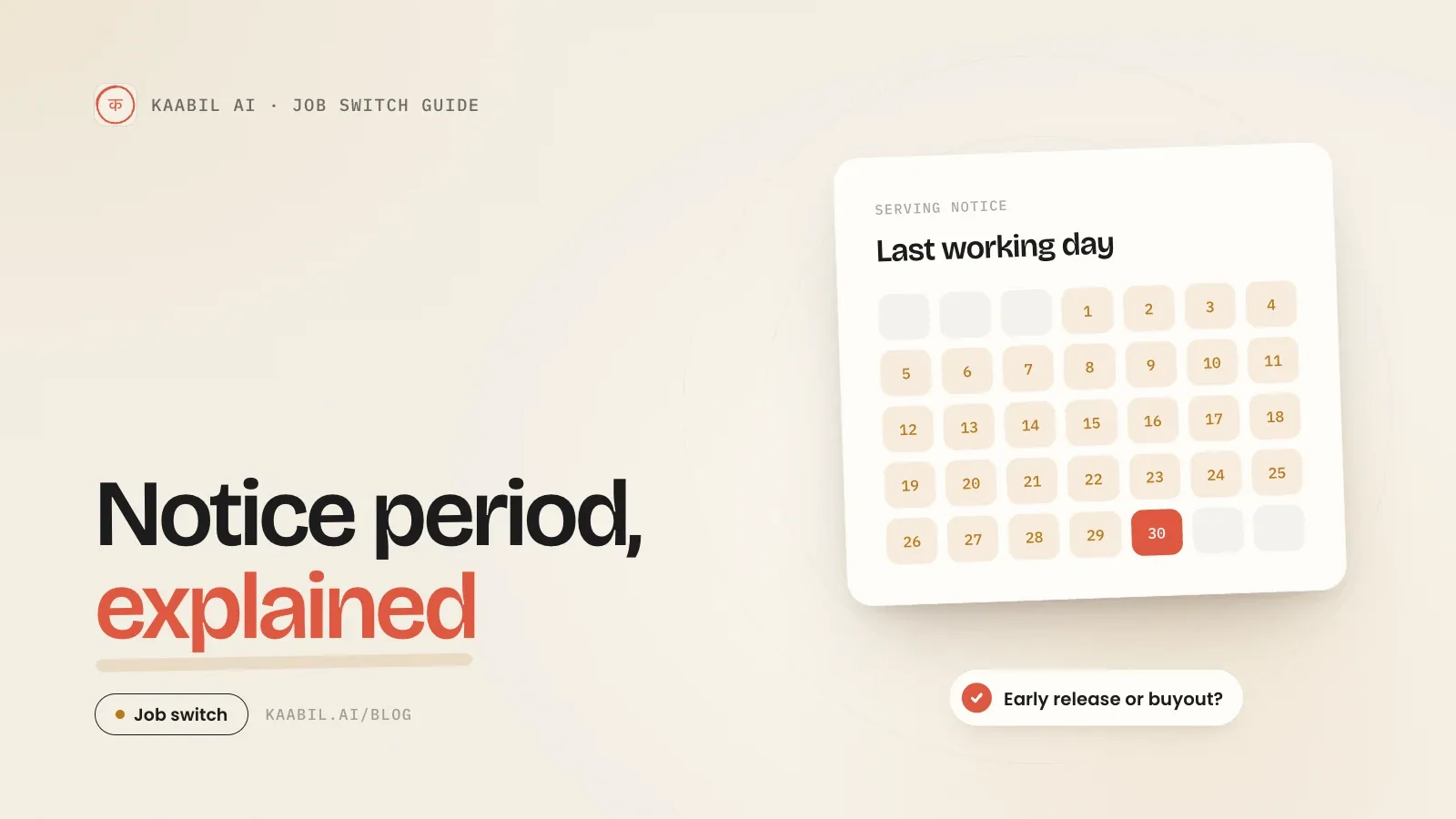
Last working day: if you resign on 1 December and your 30-day notice starts the next day, your last working day is 31 December. Companies differ on whether the resignation day counts, so confirm the date with HR in writing.
Can you leave without serving your notice period?#
You can ask, but your employer decides. The usual options are early release, a buyout, or adjusting leave you haven’t used, if the policy allows it. Leaving without agreement is risky: the company may recover pay for the days you didn’t serve and may delay your relieving and experience letters, which your next employer may ask for during background verification.
How do you write a notice period email?#
Keep it short: say you are resigning, give your last working day based on your notice period, and offer a handover. If you want an earlier date, ask for it politely and give the reason.
Sample email asking for an earlier release
Subject: Resignation and request for early release – Ankit Sharma
Dear Ms Mehta,
Please accept this email as my resignation from my role as Associate Software Engineer. As per my 60-day notice period, my last working day would be 30 January.
My new role starts in early January, so I would like to request an earlier release, on 31 December. I will complete the handover of my current tasks and documents before then, and I am open to a buyout of the remaining days if that helps.
Thank you for your support during my time here.
Regards,
Ankit Sharma
Frequently asked questions
It is the time you keep working after you resign, before your last working day, so you can hand over your work. Your offer or appointment letter sets its length, and a notice period usually applies when an employer ends your job too.
If you are not working anywhere, write “Immediate joiner” or “0 days”. If you have already joined a company, write the notice period in your appointment letter, which may be shorter during probation.
Usually calendar days, so weekends and holidays count, unless your contract says working days. Check your appointment letter or HR policy, and confirm your last working day with HR in writing.
Some employers do, especially when they need you to join quickly. Ask during the offer discussion and get it in writing, for example in your offer letter. Otherwise the buyout is usually deducted from your full and final settlement.
Only if your employer allows it. Many companies restrict leave during notice, and some extend your last working day by the leave you take. Your HR policy decides, so ask before you plan time off.
Your employer may recover pay for the days you didn’t serve from your final settlement and may delay your relieving letter. Without that letter, background verification at your next job can take longer. It depends on your contract and the company’s policy.
Sources
- Compliance Handbook for Employers Under the Four Labour Codes (Central Government Sphere), Ministry of Labour and Employment, Government of India · checked
- The Code on Wages, 2019 (No. 29 of 2019), Gazette of India, Ministry of Labour and Employment, Government of India · checked
- Government makes the four Labour Codes effective (press release), Press Information Bureau, Government of India (21 Nov 2025) · checked