Contents
- What is gratuity?
- What does gratuity mean in salary?
- What is the meaning of gratuity in a company?
- What does gratuity mean in a hotel or restaurant?
- Who is eligible for gratuity?
- Do fixed-term employees get gratuity after one year?
- Do you get gratuity after 4 years and 240 days?
- Is 5 years 7 months counted as 6 years for gratuity?
- What does gratuity mean for government employees and pension?
- How is gratuity calculated?
- Worked example: gratuity after 6 years and 7 months
- Worked example: a one-year fixed-term contract
- Why is 26 used in the gratuity calculation?
- How much gratuity will you get after 5, 10 or 20 years?
- Is gratuity calculated on basic salary or CTC?
- Is gratuity deducted from your salary?
- How does gratuity show in your salary slip?
- How does the new 50% wages rule change your gratuity?
- Why does your CTC show gratuity?
- What is the difference between PF and gratuity?
- Is there a maximum limit on gratuity?
- Is gratuity taxable in India?
- When must your employer pay gratuity?
- Can an employer refuse to pay gratuity?
- What should you check before you resign?
- Frequently asked questions
You worked at one company for years, and now you are moving on. Before you sign your exit papers, there is one payment you should check: gratuity. It is a lump sum your employer owes you for long service. Many people leave without knowing whether they qualify, or how much they should get.
This guide explains gratuity in simple words. You will learn what it means, who is eligible after the new labour codes, the formula with worked examples, why the number 26 is in it, the ₹20 lakh cap, tax, and when your employer must pay. The rules here come from the Code on Social Security, 2020, which took over from the Payment of Gratuity Act, 1972 when the four labour codes came into force on 21 November 2025.
The short version: most employees qualify after five years of continuous service, fixed-term employees after one year. The amount is 15 days' wages for every year you worked, and it must reach you within 30 days.
What is gratuity?#
Gratuity is a one-time payment your employer makes when your job ends after long service. It rewards the years you stayed, and it is paid on top of your last salary and leave encashment.
Gratuity is not a bonus your company can choose to skip. It is a legal right under Chapter V of the Code on Social Security, 2020. The Code replaced the Payment of Gratuity Act, 1972 (section 164), so older articles that quote the 1972 Act describe the same benefit under its old law. If your company offers better terms through a contract or agreement, you get the better terms (section 53(5)).
What does gratuity mean in salary?#
In salary terms, gratuity is a long-service amount linked to your basic pay. It is not paid every month: it builds up while you work and is paid out when you leave.
Many offer letters show gratuity as one line inside the CTC. That does not mean it reaches your account each month. It is the amount your employer sets aside for the day you qualify. Our LPA full form guide explains why CTC lines like this make your in-hand pay lower than your package.
What is the meaning of gratuity in a company?#
In a company, gratuity is a legal benefit your employer owes you for long service when your job ends. It equals 15 days' wages for each year you worked, and the employer pays all of it. Nothing is taken from your salary.
Illustrative example: the figures are made up. An employee whose last basic pay plus DA is ₹40,000 resigns after 8 years. The company owes ₹40,000 × 15 ÷ 26 × 8 = ₹1,84,615, paid on top of the final salary.
When people search for the Gratuity Act meaning in India, they usually mean the Payment of Gratuity Act, 1972. Since 21 November 2025, its rules sit in Chapter V of the Code on Social Security, 2020.
What does gratuity mean in a hotel or restaurant?#
In a hotel or restaurant, gratuity means a tip or service charge for the staff, often added to the bill as a percentage, such as a 20% gratuity. That is a different use of the word from the salary gratuity in this guide.
Who is eligible for gratuity?#
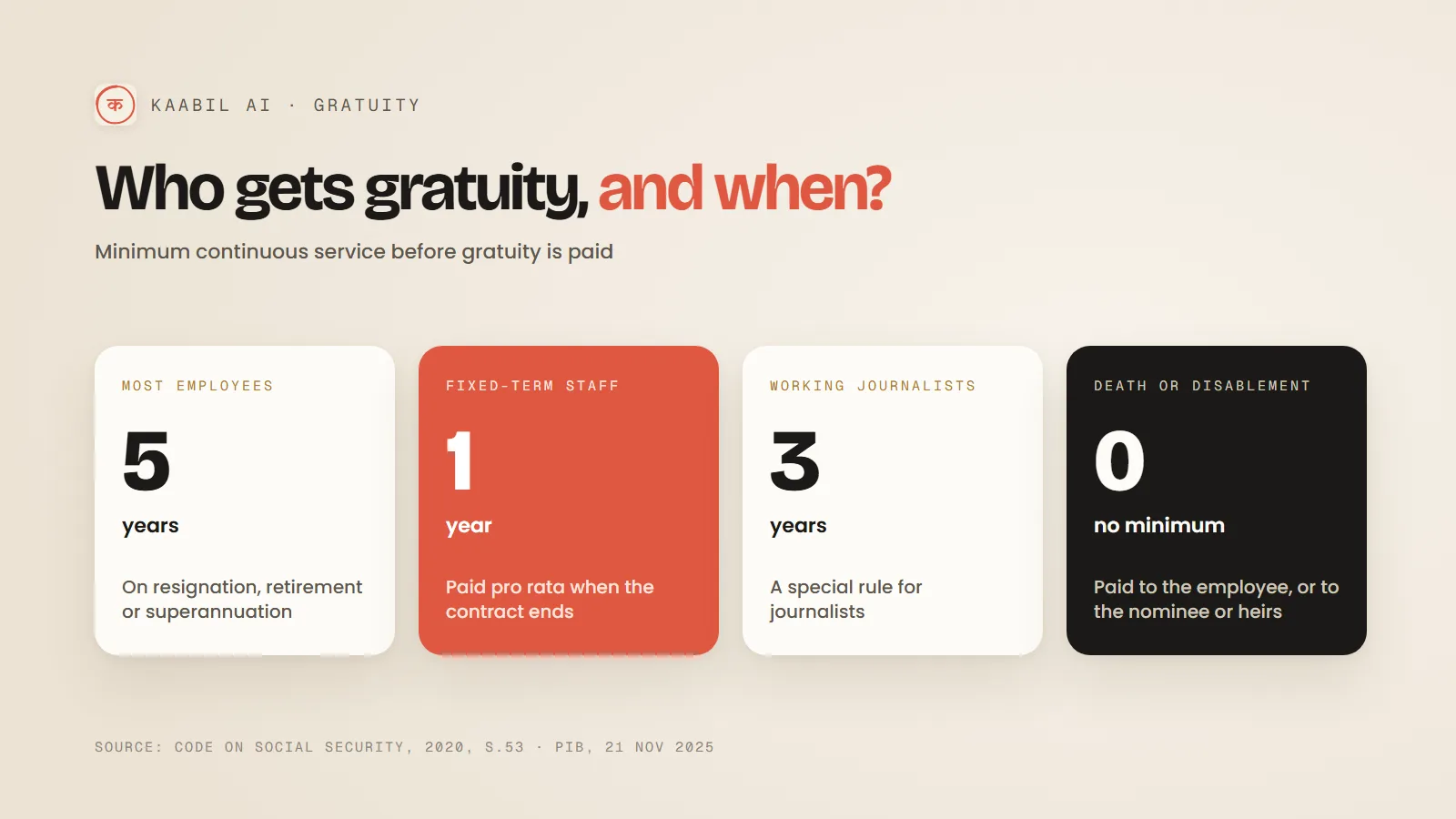
You are eligible for gratuity when your job ends after at least five years of continuous service with the same employer. The law lists when it is paid: retirement, resignation, death or disablement, or the end of a fixed-term contract (section 53(1)).
The five-year rule has clear exceptions. If the job ends because of the employee's death or disablement, or because a fixed-term contract expires, five years are not needed (section 53(1), second proviso). On death, the gratuity goes to the nominee, or to the legal heirs if there is no nominee (section 53(1)). Working journalists qualify after three years instead of five.
Government employees covered by their own gratuity rules sit outside this chapter (section 53, Explanation 1). For them, their service rules apply.
Do fixed-term employees get gratuity after one year?#
Yes. Since the labour codes took effect on 21 November 2025, fixed-term employees become eligible for gratuity after one year of continuous service, instead of five. The Press Information Bureau (PIB) confirmed this in its release that day.
A fixed-term employee is hired for a set period, such as a one-year project contract. When the contract ends, gratuity is paid pro rata, in proportion to the time worked (section 53(2)). For freshers on contract roles, this is the biggest change in the new gratuity rule.
Do you get gratuity after 4 years and 240 days?#
Possibly. The Code treats you as in continuous service for a year if you actually worked 240 days in the previous 12 months, or 190 days in a mine below ground or an establishment that works less than six days a week (section 54).
So a fifth year in which you actually worked 240 days can count as a full year of continuous service. Employers do not all apply this the same way to the five-year rule. If you are close to five years, around four years and eight months, ask HR in writing how they count your service before you resign.
Is 5 years 7 months counted as 6 years for gratuity?#
Yes, for the amount. Once you have five years of continuous service, a part year of more than six months counts as a full year (section 53(2)). So 5 years 7 months is paid as 6 years, while 5 years 5 months is paid as 5.
What does gratuity mean for government employees and pension?#
For government employees, gratuity is a one-time lump sum paid at retirement under their own service rules, separate from the monthly pension. Employees covered by those rules sit outside the Code's gratuity chapter (section 53, Explanation 1).
Death-cum-retirement gratuity received by government employees is fully exempt from income tax (Income-tax Act, 2025, section 19).
How is gratuity calculated?#
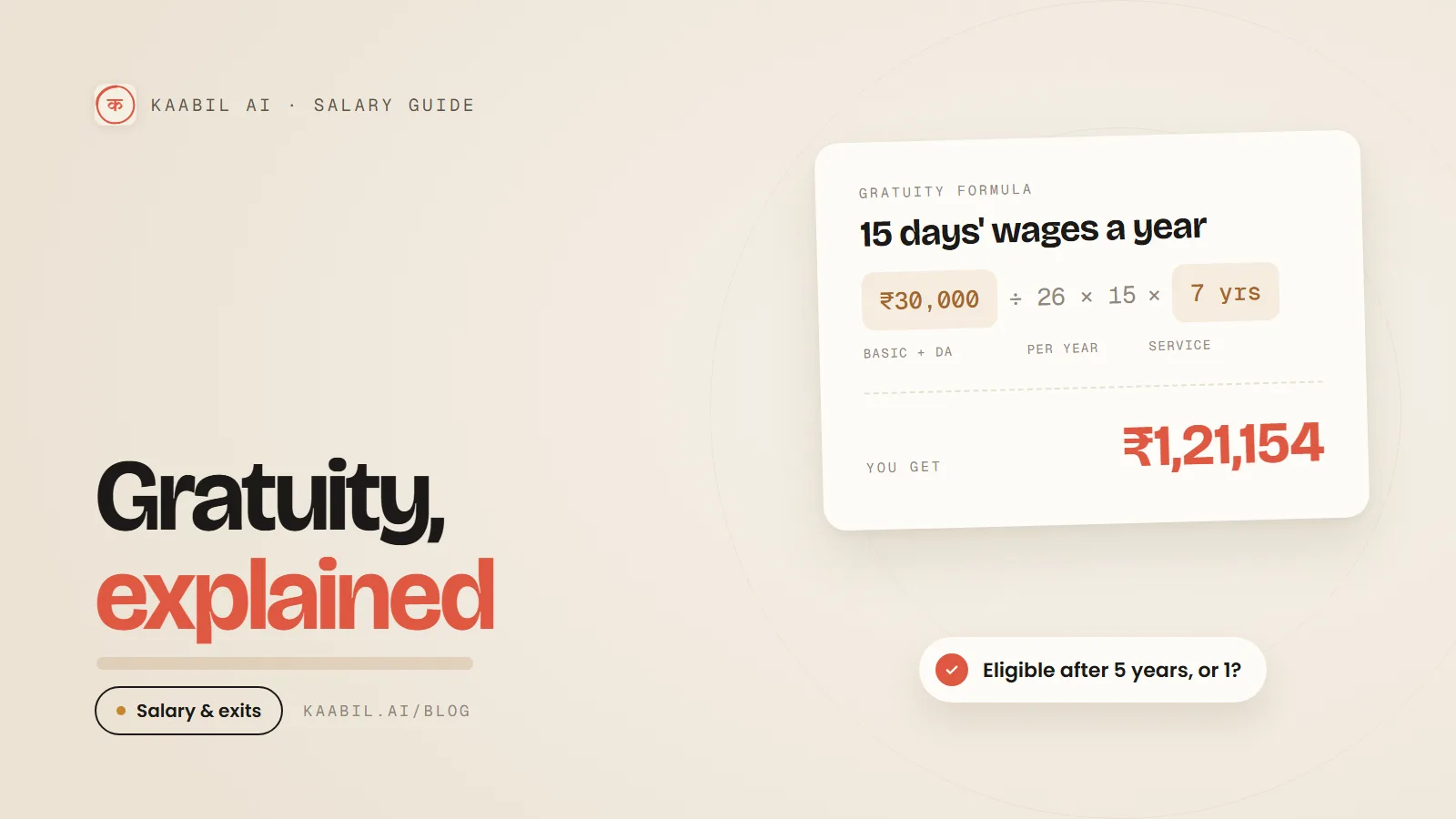
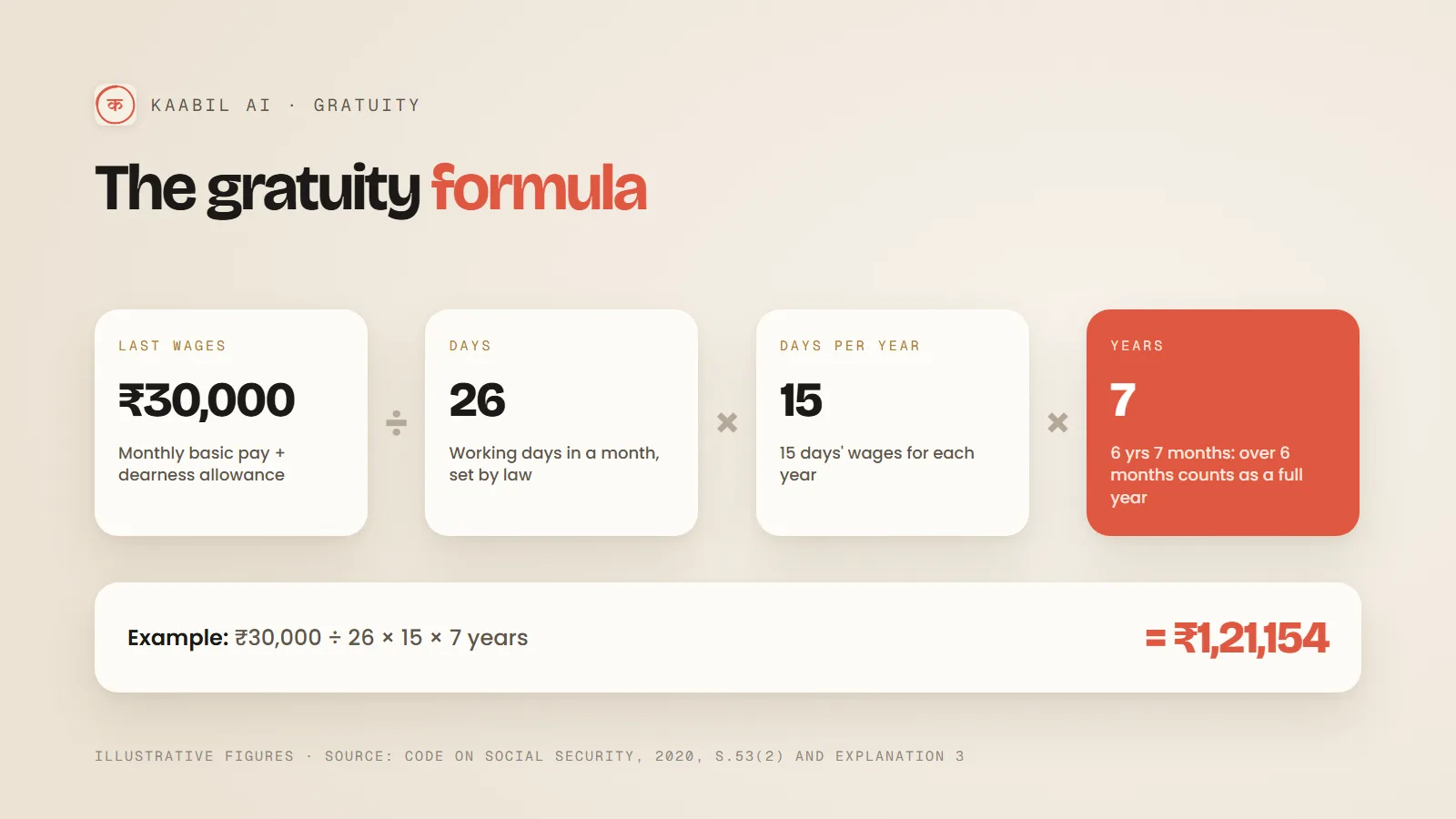
Gratuity is 15 days' wages for every completed year of service, based on your last-drawn wages. For a monthly paid employee, the law says to divide the monthly wages by 26 and multiply by 15 (section 53, Explanation 3).
So the gratuity formula is:
Gratuity = last monthly wages × 15 ÷ 26 × years of service
Two details change the answer:
- Years of service: a part year of more than six months counts as a full year (section 53(2)). Six years and seven months counts as seven years; six years and five months counts as six.
- Wages: this means your basic pay plus dearness allowance (DA), not your full salary.
Seasonal workers who do not work the whole year get seven days' wages for each season instead.
Worked example: gratuity after 6 years and 7 months#
Illustrative example: the name and figures are made up.
Rohan's last basic pay plus DA is ₹30,000 a month. He resigns after 6 years and 7 months, which counts as 7 years.
Gratuity = ₹30,000 × 15 ÷ 26 × 7 = ₹1,21,154
Each year of his service is worth about ₹17,308, so staying one more year would add roughly that amount.
Worked example: a one-year fixed-term contract#
Illustrative example: the figures are made up.
Priya joins on a one-year fixed-term contract with basic pay of ₹25,000 a month. Her contract ends after one year.
Gratuity = ₹25,000 × 15 ÷ 26 × 1 = ₹14,423
Under the old law she would have got nothing, because she had not completed five years.
Why is 26 used in the gratuity calculation?#
The law fixes 26 as the number of days in a month for gratuity (section 53, Explanation 3). It is usually explained as a month's working days after leaving out four weekly offs.
Using 26 instead of 30 makes a day's wage slightly higher, so your gratuity is slightly higher too. Fifteen days out of 26 also means each year of service earns you a little over half a month's basic pay.
How much gratuity will you get after 5, 10 or 20 years?#
Gratuity after 5 years is about 2.88 times your last monthly basic pay plus DA, because each year earns 15/26 of a month's wages. Here is what the formula gives for common salaries.
Last monthly basic + DA | After 5 years | After 10 years | After 20 years |
|---|---|---|---|
₹20,000 | ₹57,692 | ₹1,15,385 | ₹2,30,769 |
₹30,000 | ₹86,538 | ₹1,73,077 | ₹3,46,154 |
₹50,000 | ₹1,44,231 | ₹2,88,462 | ₹5,76,923 |
Illustrative figures, using the same last-drawn wages for each period. To work out your own, multiply your last monthly basic plus DA by 15, divide by 26 and multiply by your years of service. Amounts above ₹20 lakh are capped.
Is gratuity calculated on basic salary or CTC?#
Gratuity is calculated on your wages, not your CTC. Under the Code, wages mean your basic pay, dearness allowance and retaining allowance (section 2(88)).
Many parts of your salary are left out: house rent allowance (HRA), conveyance, your employer's PF contribution, bonus, overtime and commission. That is why the same 10 LPA package can give two people very different gratuity. The person with the higher basic pay gets more.
Is gratuity deducted from your salary?#
No. Under the Code, the employer pays gratuity, so nothing is deducted from your monthly salary for it. If your CTC includes a gratuity line, that amount is not paid out each month; it is the cost your employer sets aside for when you qualify.
How does gratuity show in your salary slip?#
Gratuity is usually not a monthly line on a payslip, because it is paid only when you leave. You are more likely to see it in the CTC break-up of your offer letter, and later in your full and final settlement when you exit.
How does the new 50% wages rule change your gratuity?#
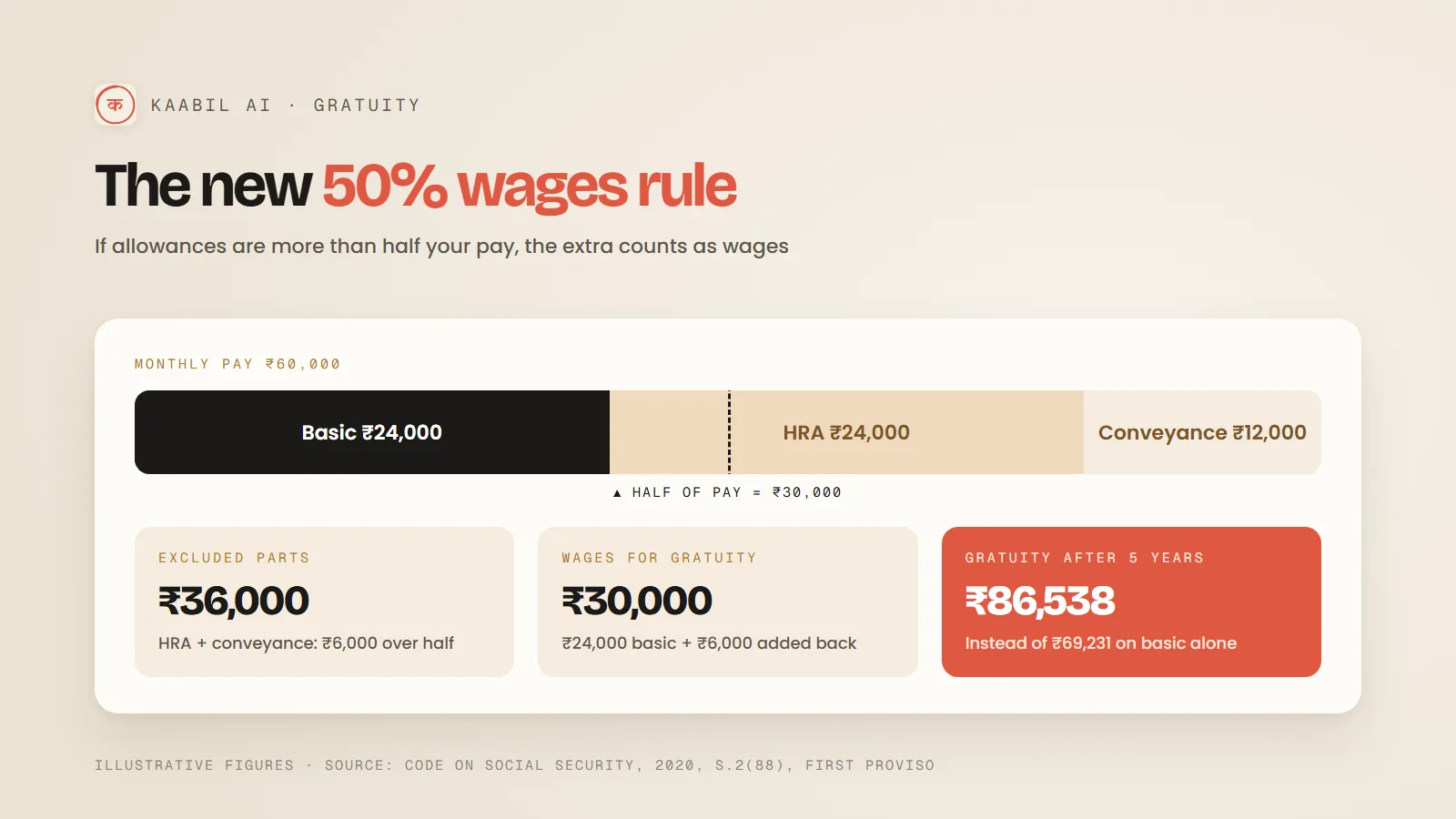
The new labour codes add a safety rule. If the excluded parts of your pay come to more than half of your total pay, the extra is added back into your wages (section 2(88), first proviso). Companies can no longer keep basic pay very low to shrink gratuity.
Illustrative example: the figures are made up.
Say your monthly pay is ₹60,000: basic ₹24,000, HRA ₹24,000 and conveyance ₹12,000. The excluded parts (HRA and conveyance) total ₹36,000, which is ₹6,000 more than half of ₹60,000. So your wages for gratuity become ₹24,000 + ₹6,000 = ₹30,000.
After 5 years, gratuity on ₹24,000 would be ₹69,231. On ₹30,000 it is ₹86,538. For many people with a low basic pay, this is the most useful change in the new gratuity rules.
Why does your CTC show gratuity?#
Many companies count gratuity inside your CTC, because it is a cost they set aside for you each year. By the formula, one year of gratuity is 15/26 of a month's basic pay, which is about 4.81% of your annual basic.
That gratuity line is not paid to you each month. If you leave before you qualify, you do not receive it. When you compare offers, look at in-hand pay. Our 10 LPA in-hand salary page shows how CTC lines turn into a monthly figure.
What is the difference between PF and gratuity?#
PF (Provident Fund) is a monthly saving that you and your employer both pay into, while gratuity is a lump sum that only your employer pays when you leave after qualifying service. Many salaried employees have both, and both are linked to basic pay.
Point | PF | Gratuity |
|---|---|---|
Who pays | You and your employer, every month | Your employer only |
When you get it | On withdrawal or retirement, as EPFO rules allow | When your job ends after qualifying service |
Based on | Your basic pay | Last basic pay plus DA, and years of service |
In your CTC | The employer's share is often inside CTC | Often shown as a CTC line |
Is there a maximum limit on gratuity?#
Yes. Gratuity cannot go above the limit notified by the Central Government (section 53(3)). The limit was raised from ₹10 lakh to ₹20 lakh with effect from 29 March 2018.
The Code lets the government change the limit by notification. Notifications made under the old Act carry on until they are replaced (section 164(2)). Most salaried people never reach the cap, but someone with a high basic pay and long service can. For example, ₹20 lakh after 20 years needs last monthly wages of about ₹1,73,333.
Is gratuity taxable in India?#
Gratuity paid under the gratuity law is tax-free up to the amount the formula gives you. The exemption sits in section 19 of the Income-tax Act, 2025, and the gratuity cap of ₹20 lakh limits the formula amount.
For employees not covered by the gratuity law, the tax-free part is the lowest of three amounts: the gratuity actually received, the limit the government notifies, and half a month's average salary for each completed year. Death-cum-retirement gratuity for government employees is fully exempt. Anything above the tax-free part is added to your salary income, so check your Form 16 or ask a tax adviser.
When must your employer pay gratuity?#
Your employer must pay gratuity within 30 days of the date it becomes payable (section 56(3)). If they pay late, they owe you simple interest for the delay, unless the delay is your fault and approved by the authority.
You should apply in writing, but the law also says your employer must work out the amount and tell you, even without an application (section 56(2)). If you disagree with the amount, or your employer refuses, you can apply to the competent authority, a labour officer who decides gratuity disputes (section 56(5)).
Can an employer refuse to pay gratuity?#
Only in narrow cases. Gratuity can be forfeited if you were dismissed for causing damage or loss to company property, up to the loss caused. It can also be wholly or partly forfeited for riotous or violent conduct, or for an offence involving moral turpitude at work (section 53(6)).
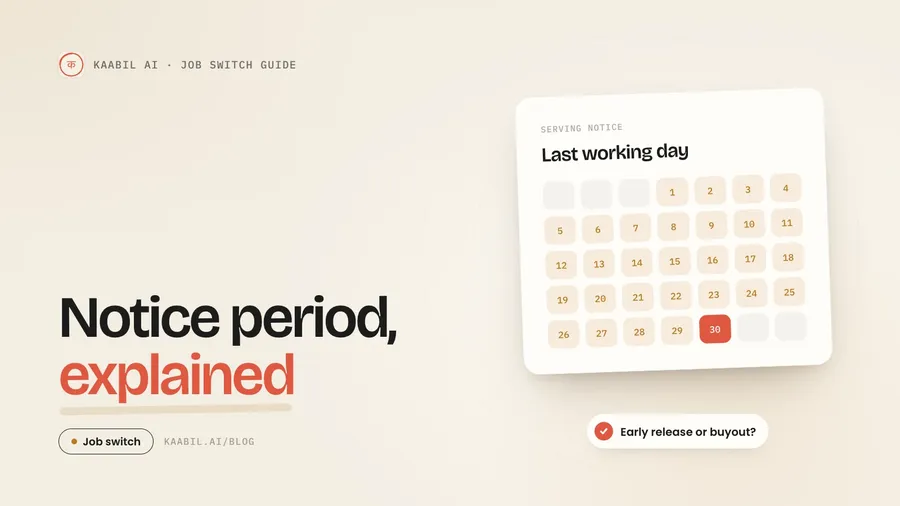
Resigning or being let go is not, by itself, a reason to deny gratuity if you meet the service rule. If a company holds back your gratuity during exit, ask for the reason in writing. Your final wages have a separate, shorter deadline; see our notice period meaning guide for how exits are settled.
What should you check before you resign?#
A few checks before you resign can protect your gratuity:
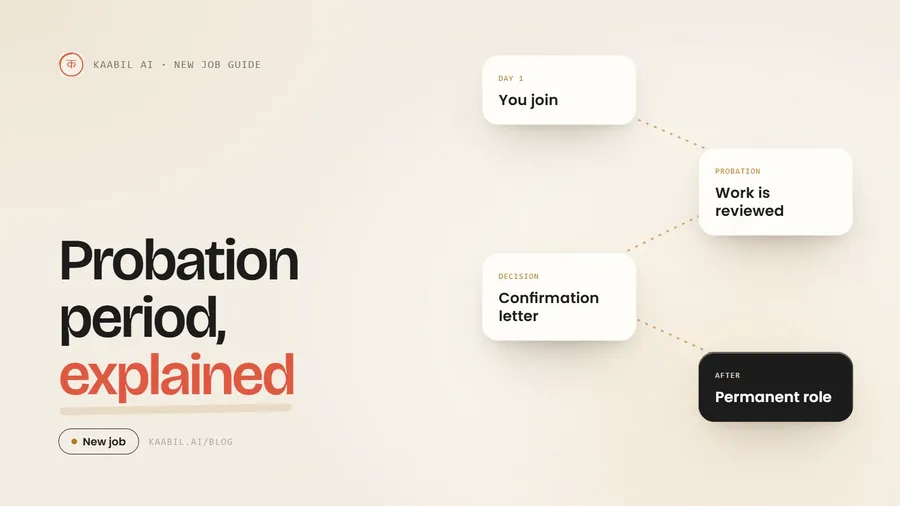
- Count your continuous service from your joining date in your appointment letter. Probation counts; see probation period meaning.
- If you are close to five years, ask HR in writing how they count service before you set your last day.
- Check your last basic pay and DA on your payslip, and whether the 50% wages rule applies to you.
- Make sure your nominee details are filled in with HR.
- Write your gratuity claim into your resignation letter or exit email, and keep a copy.
- Collect your relieving letter and experience letter before your last day.
Planning your next move after five good years? On the Kaabil App, the Career Agent contacts recruiters for you and sends only what you approve, so you can line up your next role before you serve notice.
Frequently asked questions
Gratuity in salary is a long-service amount linked to your basic pay plus DA. It is not paid monthly: your employer pays it as one lump sum when you leave after five years of continuous service, or after one year on a fixed-term contract.
In a company, gratuity is a legal benefit your employer pays you for long service when your job ends. It equals 15 days' wages for each year worked, and the employer pays all of it; nothing comes out of your salary.
No. The law makes the employer pay gratuity, so nothing is deducted from your monthly salary for it. If your CTC shows a gratuity line, that amount is set aside by the employer and paid only when you leave after qualifying.
Gratuity is usually not a monthly line on a payslip, because it is paid only when you leave. You are more likely to see it in the CTC break-up of your offer letter, and later in your full and final settlement.
By the formula, one year of gratuity is 15/26 of a month's basic pay plus DA, which works out to about 4.81% of your annual basic. If your offer letter lists gratuity inside CTC, this is the figure to check it against.
Gratuity = last monthly basic pay plus DA × 15 ÷ 26 × years of service. The 15 stands for 15 days' wages a year, and 26 is the number of days in a month the law sets. A part year over six months counts as a full year.
After 5 years you get about 2.88 times your last monthly basic pay plus DA. For example, ₹20,000 gives about ₹57,692, ₹30,000 about ₹86,538 and ₹50,000 about ₹1,44,231, using basic × 15 ÷ 26 × 5.
Yes. Resignation is one of the events the law lists, so you get gratuity when you resign after at least five years of continuous service. Your employer must pay it within 30 days of it becoming due, with interest if late.
Usually not under the five-year rule, because you are short of five years of continuous service. The Code's 240-day rule for counting a year is applied differently by employers, so ask HR in writing. Fixed-term staff qualify after one year.
Yes. Once you complete five years of continuous service, any part year of more than six months counts as a full year. So 5 years 7 months is paid as 6 years, but 5 years 5 months is paid as 5 years.
PF is a monthly saving that you and your employer both pay into, and you can withdraw it as EPFO rules allow. Gratuity is a lump sum that only your employer pays, when you leave after qualifying service.
For government employees, gratuity is a lump sum paid at retirement under their own service rules, separate from the monthly pension. Death-cum-retirement gratuity received by government employees is fully exempt from income tax under section 19 of the Income-tax Act, 2025.
In a hotel or restaurant, a 20% gratuity means a tip or service charge equal to 20% of the bill, paid to the staff. It is different from salary gratuity, where one year's gratuity is about 4.81% of annual basic pay.
Since 21 November 2025, gratuity comes under the Code on Social Security, 2020. Fixed-term employees qualify after one year instead of five, and if allowances exceed half your pay, the extra now counts towards gratuity.
Gratuity is capped at the limit the Central Government notifies. The cap has been ₹20 lakh since 29 March 2018, and gratuity paid under the gratuity law is tax-free up to the formula amount within that cap.
Sources
- The Code on Social Security, 2020 (No. 36 of 2020), Gazette text, PRS Legislative Research (copy of the Gazette of India) · checked
- Government makes the four Labour Codes effective (press release), Press Information Bureau, Government of India · checked
- Income-tax Act, 2025: Section 19, Income Tax Department, Government of India · checked
- Govt notifies law for doubling tax-free gratuity to Rs 20 lakh, Deccan Chronicle (31 Mar 2018) · checked