Contents
If HR asks you to “complete your BGV”, the company is about to check the details on your resume and joining forms. Here is what that means, what gets checked, and how to get through it without delays.
What does BGV mean in a job?#
BGV, or background verification, is how an employer confirms that you are who you say you are, and that your education and work history are as you described them. Companies run it themselves or hire a background verification agency. Checks are often more detailed for roles that handle money, customer data or client projects.
What is the background verification process?#
The steps differ by company, but most background checks follow this order.
- Offer and consent. After you accept an offer, HR sends a BGV form or link and asks you to sign a consent or authorisation.
- Documents. You upload ID, address proof, education certificates and, if you have worked before, letters from past employers.
- Checks. The employer or agency contacts your university, past employers and references, and may run address and criminal record checks.
- Report. The agency sends the employer a report. Many agencies use colours, such as green for verified, amber for a mismatch or missing information, and red for a serious discrepancy.
- Decision. If something doesn’t match, HR usually asks you to explain it or send another document before deciding.
What do companies check in BGV?#
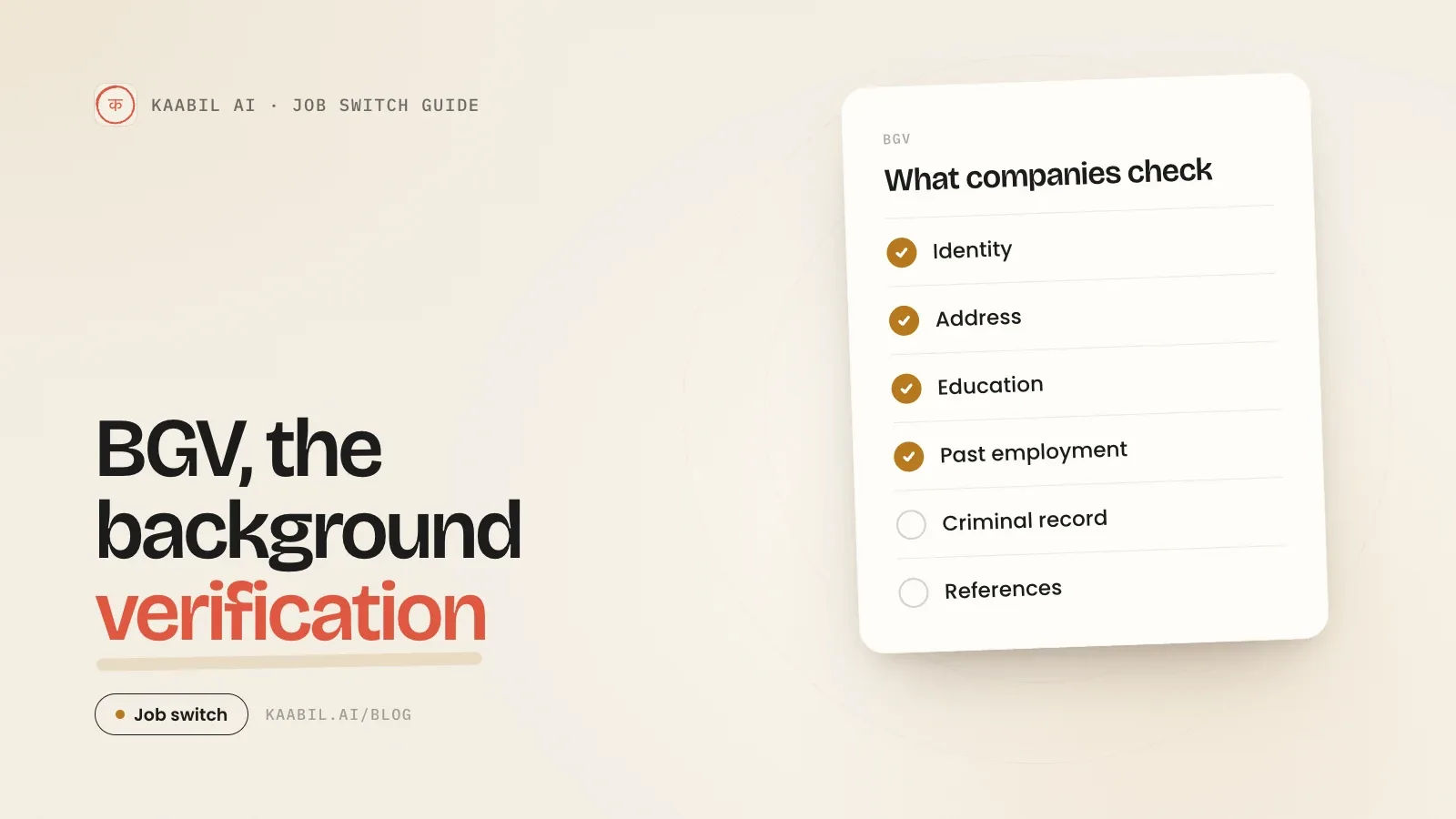
Check | What is verified | Documents you may be asked for |
|---|---|---|
Identity | That you are the person who applied | Aadhaar, PAN card, passport or voter ID |
Address | Your current and permanent address | Address proof; some checks include a visit to the address |
Education | Degree, university, year of passing and marks | Degree or provisional certificate and mark sheets |
Past employment | Company, job title, dates and sometimes last salary | Offer, relieving and experience letters, and payslips |
Criminal record | Court or police records | Usually only your consent and address details |
References | How former managers or teachers describe your work | Names and contact details of your references |
Some employers also match your employment dates against your EPF service history, linked to your UAN, so the dates on your resume should match those records.
How long does BGV take?#
Usually a few days to a few weeks. Identity and address checks are quick. Education and employment checks take longer because they depend on how fast your university and former employers reply. Some companies let you join while the check is still running, with the offer subject to a clear report.
While the check runs, compare offers on what you take home: our salary guides show the in hand salary for common CTCs from 3.5 to 20 LPA.
Is BGV done for freshers?#
Yes. For freshers the check is usually lighter: identity, address and education, and sometimes a criminal record check. Keep your mark sheets and your provisional or degree certificate ready, because the education check depends on your university replying.
What can cause a BGV to fail?#
- Dates that don’t match: joining or leaving dates on your resume differ from your relieving letter or EPF records.
- A job title or company name that doesn’t match what your past employer confirms.
- A degree, certificate or mark sheet that can’t be verified.
- A previous job left out of the form, when it shows up in your EPF records.
- No relieving letter from a past job, for example because the notice period wasn’t served.
A mismatch you explain up front is usually easier to resolve than one the check finds first. If your offer letter says it is subject to satisfactory verification, the employer can withdraw it; what happens depends on the company’s policy and your contract.
Worked examples: fixing a mismatch before it becomes a red flag#
Example 1, a date mismatch. Neha’s resume says she worked at her first company from 2023 to 2025, and in her BGV form she typed June 2023 as her joining date. Her relieving letter says 3 July 2023 to 28 February 2025. Before submitting, she corrects the form to July 2023 – February 2025, uploads the relieving letter, and tells HR that her resume shows years only. Now the form, the letter and her EPF record agree.
Example 2, a degree not yet issued. Rohit is a fresher whose degree certificate hasn’t been issued yet. He uploads his provisional certificate and final-semester mark sheet, and tells HR when the degree is expected. Many employers accept this and complete the education check once the degree arrives.
How do you prepare for BGV?#
Use this checklist before you fill in the BGV form.
- Make your resume and BGV form match: the same company names, job titles and dates, with month and year.
- Keep scans of your ID, address proof, mark sheets, degree or provisional certificate, and offer, relieving and experience letters.
- Tell your references that they may be contacted.
- Explain gaps and short jobs honestly in the form, before the check finds them.
- Reply quickly when HR or the agency asks for something; missing documents are a common cause of delay.
Frequently asked questions
BGV stands for Background Verification. It is the check an employer runs to confirm your identity, address, education and past employment, usually after making you an offer.
Usually soon after you accept the offer. HR sends a BGV form or link, you sign a consent and upload documents, and the checks run before or soon after your joining date.
Usually ID proof such as Aadhaar or PAN, address proof, mark sheets and your degree or provisional certificate. If you have worked before, add offer, relieving and experience letters, and sometimes payslips. Your BGV form lists exactly what your employer needs.
Sometimes. Some employers ask past employers to confirm your last salary, or ask you for payslips. State your current CTC accurately in interviews and forms, because a mismatch with your payslips can raise questions.
It can, if the report shows a serious discrepancy and your offer letter makes the offer subject to verification. It depends on the employer’s policy and your contract. Small mismatches are usually resolved by explaining them and sending the right document.
Sources
- The Digital Personal Data Protection Act, 2023 (No. 22 of 2023), Ministry of Electronics and Information Technology, Government of India · checked
- DPDP Rules, 2025 Notified (PIB backgrounder), Press Information Bureau, Government of India (17 Nov 2025) · checked
- Digital Police portal (citizen services), Ministry of Home Affairs / National Crime Records Bureau · checked