
Contents
- TPO Full Form and Role in College Placements
- Key Responsibilities of a Training and Placement Officer
- Why Student Readiness Must Be Tracked Before Placement Season
- Common Challenges Faced by Placement Teams
- 8 Student Readiness Metrics Every Placement Cell Should Track
- 1. Assessment Participation Rate
- 2. Overall Placement Readiness Rate
- 3. Technical Skill Performance
- 4. Aptitude and Problem-Solving Scores
- 5. Communication and Interview Readiness
- 6. Skill-Gap Improvement Rate
- 7. Resume and Career Profile Completion
- 8. Interview-to-Offer Conversion Rate
- How to Conduct Skill Gap Analysis by Student Cohort
- Step 1: Group Students into Relevant Cohorts
- Step 2: Establish Skill Benchmarks
- Step 3: Conduct Baseline Assessments
- Step 4: Compare Results and Identify Gaps
- Step 5: Assign Targeted Training
- Step 6: Reassess and Monitor Improvement
- Free Student Placement Readiness Tracker Template
- How TPOs Can Use the Tracker
- How Kaabil Campus Helps TPOs Track Student Readiness
- Key Kaabil Campus Capabilities
- Final Thoughts
- Frequently Asked Questions
A placement drive is approaching. Recruiters are confirmed. But how many students are actually ready?
For many colleges, this question becomes important only when placement season is just a few weeks away.
Students have attended training sessions, completed academic courses and participated in workshops. Yet when recruitment begins, some struggle with aptitude tests, technical assessments, communication or interviews.
For a training and placement officer, the real challenge is not just organizing recruitment drives. It is understanding which students are prepared, where skill gaps exist and what support is needed before companies arrive.
However, tracking hundreds or thousands of students through spreadsheets, separate assessment tools and manual reports can make this difficult.
A more structured approach combines regular assessments, skill gap analysis, student-level tracking and measurable readiness indicators.
In this blog, we will explain the responsibilities of a training and placement officer, eight essential readiness metrics, how to conduct a cohort-level skill gap analysis and how Kaabil Campus can help institutions track student preparation.
TPO Full Form and Role in College Placements#
A training and placement officer is responsible for preparing students for employment and coordinating campus recruitment activities. The role includes organizing training, conducting placement drives, building recruiter relationships, tracking student readiness and helping students connect with suitable career opportunities.
Key Responsibilities of a Training and Placement Officer#
The role of a TPO extends beyond inviting companies for recruitment.
A training and placement officer typically works with faculty members, students, recruiters and college management to coordinate placement activities.
Key responsibilities include:
- Student Readiness: Identify technical, aptitude and communication skill gaps.
- Placement Training: Organize workshops, mock interviews and aptitude preparation.
- Recruiter Coordination: Connect with employers and schedule campus recruitment drives.
- Student Profiles: Maintain updated resumes, qualifications and placement eligibility records.
- Placement Reporting: Track applications, interviews, job offers and recruitment outcomes.
The tpo meaning becomes clearer when considering the complete student journey, from early preparation to employment opportunities.
A well-organized training and placement cell helps connect academic learning with industry expectations.
Why Student Readiness Must Be Tracked Before Placement Season#
Many colleges measure placement performance primarily through the number of companies visiting campus and students receiving offers.
Although these metrics are important, they provide limited insight into how prepared students were before recruitment.
For example, a student may have strong academic results but struggle with aptitude tests. Another may demonstrate technical knowledge but lack confidence during interviews.
If these gaps are discovered only during placement drives, there may be insufficient time to address them.
This is why readiness tracking should begin well before the final semester.
Common Challenges Faced by Placement Teams#
- Limited Readiness Visibility: Difficulty identifying students who are prepared for recruitment.
- Disconnected Student Data: Assessment results, resumes and training records stored across different platforms.
- Late Skill-Gap Identification: Weaknesses becoming visible only during recruitment.
- Manual Reporting: Significant time spent updating spreadsheets and preparing reports.
- Generic Training: Similar preparation provided to students with different needs.
A structured placement management system can help organize student records, readiness information and placement activities.
The goal is to move from last-minute preparation to continuous monitoring and improvement.
8 Student Readiness Metrics Every Placement Cell Should Track#
An effective placement cell needs measurable indicators to understand whether students are progressing toward recruitment readiness.
Tracking the right metrics can help institutions identify struggling students, evaluate training programs and plan targeted improvements.
Here are eight important metrics every training and placement cell should monitor.
1. Assessment Participation Rate#
This metric measures how many eligible students complete assigned assessments.
For example, if 800 out of 1,000 students complete an aptitude assessment, the participation rate is 80%.
Low participation may indicate limited engagement or missed preparation activities.
What to track: Assessment completion by batch, department and semester.
2. Overall Placement Readiness Rate#
Placement readiness measures the percentage of assessed students meeting institution-defined preparation criteria.
These criteria may include aptitude, technical knowledge, communication and resume readiness.
For example, colleges can establish different readiness thresholds for software development, sales and analytics roles.
What to track: Percentage of students meeting defined readiness benchmarks.
3. Technical Skill Performance#
Technical assessments help determine whether students have the job-related knowledge expected for particular roles.
For engineering students, this may include programming, databases or domain-specific subjects.
For management students, relevant areas may include business analysis, marketing or financial fundamentals.
What to track: Technical assessment scores and improvement across attempts.
4. Aptitude and Problem-Solving Scores#
Many campus recruitment processes include quantitative aptitude, logical reasoning and verbal ability assessments.
Students may perform well academically but require additional practice in timed aptitude tests.
Monitoring these results helps placement teams identify students who need foundational support.
What to track: Aptitude scores, completion rates and performance trends.
5. Communication and Interview Readiness#
Communication skills play an important role in interviews, group discussions and workplace interactions.
Colleges can evaluate students through presentations, mock interviews and structured communication assessments.
For example, students may understand technical concepts but struggle to explain their academic projects clearly.
What to track: Communication assessment results, mock interview performance and areas for improvement.
6. Skill-Gap Improvement Rate#
Identifying weaknesses is useful only when institutions measure whether students are improving.
A skill gap analysis compares current performance with expected skill levels and tracks progress after training.
For example, an aptitude score increasing from 45% to 70% after targeted preparation indicates measurable improvement.
What to track: Baseline scores, reassessment results and changes over time.
7. Resume and Career Profile Completion#
Students need professional profiles that clearly communicate relevant qualifications, skills, internships and projects.
Incomplete or outdated resumes can create additional work during recruiter outreach.
Tracking profile completion helps ensure students are prepared when suitable opportunities become available.
What to track: Updated resumes, verified skills, completed projects and relevant credentials.
8. Interview-to-Offer Conversion Rate#
Readiness assessments should eventually be connected with actual recruitment outcomes.
Interview-to-offer conversion measures the proportion of interviewed students who receive job offers.
A low conversion rate may indicate challenges in technical interviews, communication or alignment with job requirements.
What to track: Interview attendance, offers received and conversion trends by department or role.
How to Conduct Skill Gap Analysis by Student Cohort#
A skill gap analysis helps colleges identify the difference between students' current capabilities and the skills required for employment.
Instead of reviewing only individual scores, TPOs can analyze readiness by department, batch, semester or target job role.
This makes training programs more focused and easier to manage.
Step 1: Group Students into Relevant Cohorts#
The first step is organizing students by department, academic year or career interests.
For example, a college may create separate cohorts for Computer Science, Mechanical Engineering, Electronics and MBA students.
Grouping students helps compare performance among learners preparing for similar opportunities.
Step 2: Establish Skill Benchmarks#
Each cohort should have clearly defined expectations.
For example, students preparing for software development roles may be assessed in programming, logical reasoning, databases and communication.
Benchmark scores should reflect institutional goals and relevant job requirements.
Step 3: Conduct Baseline Assessments#
Students complete assessments to measure their current knowledge and skills.
Results provide a starting point for evaluating college placement readiness and identifying priority areas.
Step 4: Compare Results and Identify Gaps#
The placement cell can compare cohort averages with established benchmarks.
A simple example:
Skill Area | Current Average | Target | Gap |
Technical Skills | 72% | 75% | 3 percentage points |
Aptitude | 58% | 75% | 17 percentage points |
Communication | 64% | 75% | 11 percentage points |
Resume Readiness | 80% | 85% | 5 percentage points |
Illustrative data only.
In this example, aptitude and communication require greater attention than resume readiness.
Step 5: Assign Targeted Training#
Based on the results, institutions can organize additional workshops, practice assessments and learning activities.
Students requiring aptitude support can receive structured practice, while those struggling with interviews can participate in mock interview sessions.
Step 6: Reassess and Monitor Improvement#
After training, students should complete follow-up assessments.
Comparing new results with baseline scores helps determine whether the intervention worked.
This process makes skill gap analysis an ongoing improvement activity rather than a one-time assessment.
Free Student Placement Readiness Tracker Template#
Not every institution begins with a dedicated placement management system.
A simple spreadsheet can help the training and placement cell establish a basic student readiness tracking process.
Below is a sample tracker structure.
Student ID | Department | Aptitude | Technical | Communication | Resume Status | Next Action |
ST001 | CSE | 82% | 78% | 75% | Complete | Mock interview |
ST002 | ECE | 55% | 70% | 60% | Pending | Aptitude training |
ST003 | MBA | 76% | 74% | 85% | Complete | Recruiter outreach |
ST004 | CSE | 48% | 62% | 58% | Pending | Skill improvement plan |
Illustrative student records.
A tracker can also include assessment dates, readiness status, training attendance and placement outcomes.
How TPOs Can Use the Tracker#
Placement teams can update the tracker after each assessment cycle and review students requiring additional support.
For example, students performing below defined aptitude benchmarks can be assigned targeted practice before their next assessment.
However, as student numbers increase, maintaining multiple spreadsheets becomes difficult.
A centralized placement management system can help institutions organize readiness information, monitor progress and reduce manual reporting.
How Kaabil Campus Helps TPOs Track Student Readiness#
Managing assessments, student performance, training activities and recruiter outreach across separate tools can create additional work for a training and placement officer.
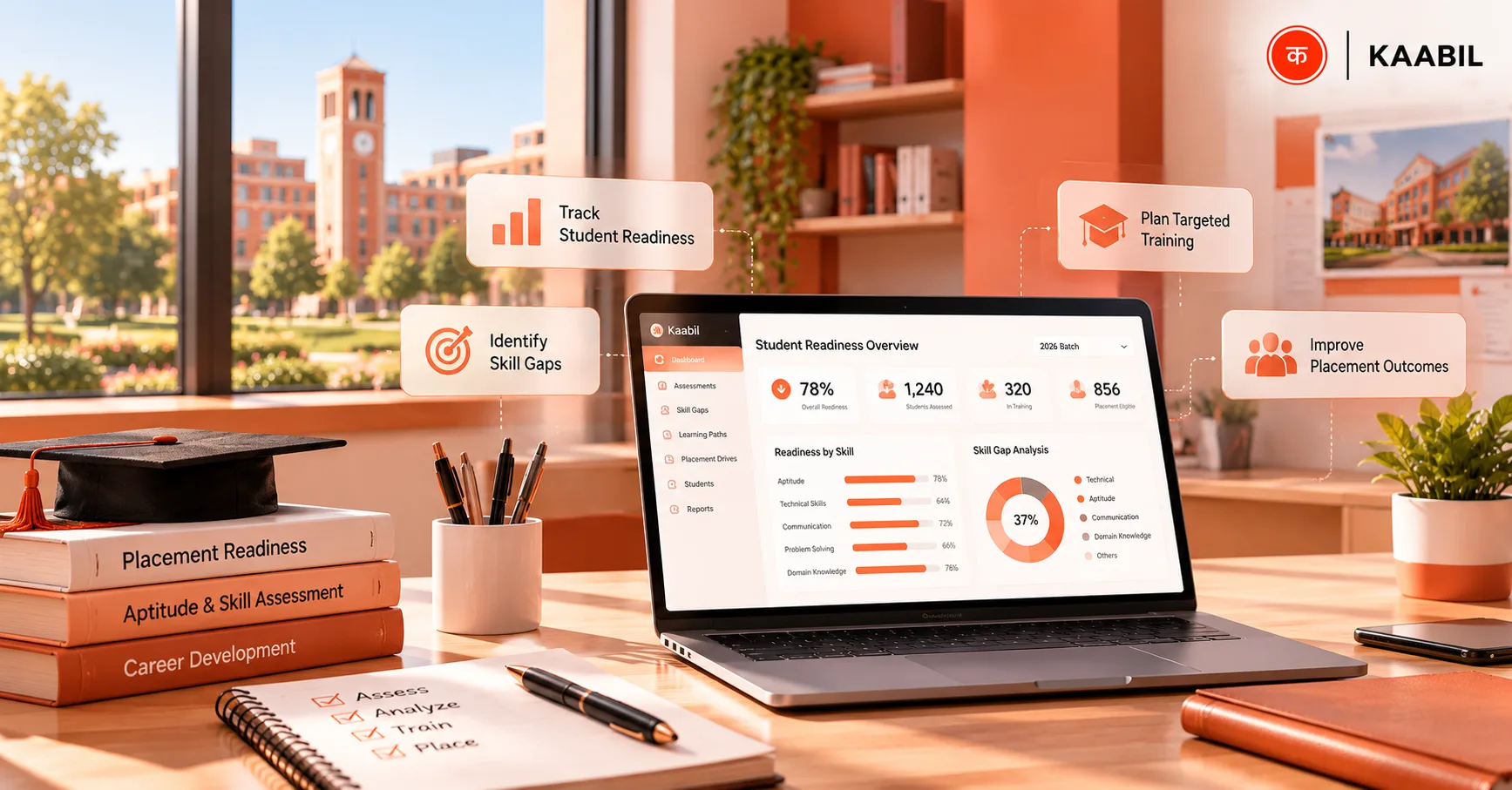
Kaabil Campus brings these activities into a connected platform designed to help colleges measure readiness and support students before placement season.
Instead of depending entirely on spreadsheets, TPOs can access readiness information across students and cohorts.
Key Kaabil Campus Capabilities#
- Institution Dashboard: Provides student-level and cohort-level visibility into readiness, participation and activity.
- Faculty-Authored Assessments: Allows institutions to create curriculum-aligned assessments using their own materials.
- Skill-Gap Learning Paths: Supports targeted improvement activities by batch, department or curriculum.
- Credentials and Certifications: Helps students demonstrate assessed capabilities through shareable credentials.
- Redrob Score: Provides an assessment-based signal of demonstrated skills.
- Reporting and Nudges: Helps placement teams identify inactive students, missed assessments and incomplete readiness activities.
- Campus Pass AI Agent: Supports job discovery, application activity and recruiter outreach as part of the placement journey.
For TPOs, the main benefit is greater visibility into which students are prepared and which need additional support.
For institutions, it connects assessment, improvement and placement assistance within one structured journey.
Kaabil Campus can help a placement cell move from reactive placement management toward continuous student readiness tracking.
Final Thoughts#
Successful campus placements require more than inviting recruiters and organizing last-minute training programs.
For a training and placement officer, understanding student readiness before recruitment begins is essential for planning relevant preparation activities.
Tracking assessment participation, technical performance, aptitude, communication, skill improvements and interview outcomes provides a clearer picture of student capabilities.
A regular skill gap analysis also helps institutions identify where targeted training can make the greatest difference.
While spreadsheets can support basic tracking, a connected placement management system can make cohort monitoring and reporting more manageable.
Kaabil Campus supports this approach by bringing together assessments, readiness dashboards, learning paths, credentials and placement assistance.
Ultimately, effective placement management is not just about counting job offers. It is about understanding student readiness early enough to make meaningful improvements.
Frequently Asked Questions
The tpo full form is Training and Placement Officer. A TPO manages student placement preparation, recruiter coordination, training activities and campus recruitment processes.
A training and placement officer organizes placement drives, coordinates with recruiters, tracks student readiness and supports skill development. The role connects students with suitable employment opportunities.
A placement cell can track readiness through assessments, skill-gap dashboards, resume completion, mock interview results and training progress. Regular reviews help identify students needing additional support.
Important metrics include assessment participation, placement readiness, technical performance, aptitude scores, communication skills, skill gap analysis, resume completion and interview-to-offer conversion.
Kaabil Campus provides student and cohort readiness dashboards, assessments, learning paths, credentials and reporting tools. Its Campus Pass also supports job discovery and recruiter outreach.

Written by