

Contents
- What Placement Aptitude Tests Measure
- Common Sections in Placement Aptitude Tests with Sample Questions
- 1. Quantitative Aptitude
- 2. Logical Reasoning
- 3. Verbal Ability
- 4. Domain-Specific Knowledge
- How Colleges Should Run Regular Aptitude Assessment Cycles
- Step 1: Begin with a Baseline Assessment
- Step 2: Identify Priority Skill Areas
- Step 3: Introduce Targeted Practice
- Step 4: Conduct Mock Placement Tests
- Step 5: Review Results and Reassess
- Suggested Assessment Schedule
- Turning Aptitude Scores into Skill-Gap Improvement Plans
- Example: Batch-Level Skill-Gap Analysis
- Building an Improvement Plan
- How Online Aptitude Tests Simplify Placement Preparation
- How Kaabil Campus Helps Colleges Prepare Students for Placement Tests
- Key Capabilities of Kaabil Campus
- Make Every Assessment Count
- Final Thoughts
- Frequently Asked Questions
A student can score well in college exams and still struggle to clear the first round of a placement drive.
Every year, colleges prepare students for campus recruitment through training sessions, workshops and mock interviews. Yet many students struggle with aptitude tests, technical assessments and problem-solving questions when recruitment begins.
The challenge is not always a lack of academic knowledge. Students may understand concepts but find it difficult to apply them under time pressure or unfamiliar assessment formats.
For Training and Placement Officers (TPOs), identifying these gaps only during placement season leaves limited time for improvement.
This is where an aptitude test for placement becomes valuable.
Regular assessments help colleges understand student strengths, identify learning gaps and provide targeted preparation before actual recruitment drives.
Instead of relying only on final-year training, institutions can use an online aptitude test, practical skill assessments and structured feedback to make placement preparation more measurable.
In this blog, we will explore what placement aptitude tests measure, common test sections with sample questions, how colleges can organize assessment cycles, and how skill gap analysis.
What Placement Aptitude Tests Measure#
An aptitude test for placement evaluates a student's ability to solve problems, interpret information, apply reasoning and communicate effectively.
Many employers use aptitude assessments during the initial stages of campus recruitment to evaluate candidates against role-specific requirements.
Unlike academic examinations, placement assessments often focus on applying knowledge within a limited time.
Common skills evaluated include:
- Numerical Ability: Working with numbers, percentages, ratios and data interpretation.
- Logical Reasoning: Identifying patterns, relationships and logical conclusions.
- Verbal Ability: Understanding written information, grammar and vocabulary.
- Problem-Solving: Applying concepts to unfamiliar situations.
- Technical Knowledge: Demonstrating subject-specific knowledge required for a role.
For colleges, these assessments provide a clearer understanding of students' recruitment readiness.
An employability test may cover a broader range of capabilities, including communication, technical skills and workplace readiness.
However, aptitude scores alone cannot determine whether a student will succeed in a job. They should be considered alongside academic performance, practical projects, interviews and other skill assessments.
Common Sections in Placement Aptitude Tests with Sample Questions#
The structure of an aptitude test for placement varies across companies, industries and job roles.
However, most campus recruitment assessments include some combination of quantitative aptitude, logical reasoning, verbal ability and domain-specific questions.
Understanding these sections helps colleges design relevant preparation activities.
1. Quantitative Aptitude#
Quantitative aptitude evaluates numerical reasoning and the ability to solve mathematical problems. Common topics include percentages, profit and loss, ratios, averages, time and work, speed and distance, and data interpretation.
Sample Question:
A student scores 72 marks out of 90 in an assessment. What is the percentage score?
A. 75%
B. 80%
C. 82%
D. 85%
Correct Answer: B. 80%
Explanation: (72 ÷ 90) × 100 = 80%.
Preparation Tip: Colleges can introduce timed numerical practice sessions to improve calculation accuracy and speed.
2. Logical Reasoning#
Logical reasoning measures the ability to identify patterns, evaluate information and reach conclusions.
Common topics include number series, coding-decoding, syllogisms, directions, seating arrangements and analytical reasoning.
Sample Question:
Find the next number in the series:
2, 6, 12, 20, 30, ?
A. 36
B. 40
C. 42
D. 44
Correct Answer: C. 42
Explanation: The differences are 4, 6, 8, 10 and 12. Therefore, 30 + 12 = 42.
Preparation Tip: Regular reasoning exercises can help students recognize patterns and develop structured problem-solving approaches.
3. Verbal Ability#
Verbal ability evaluates reading comprehension, vocabulary, grammar and written communication.
These skills are relevant across technical and non-technical roles.
Sample Question:
Choose the grammatically correct sentence.
A. She have completed the assignment.
B. She has completed the assignment.
C. She having completed the assignment.
D. She has complete the assignment.
Correct Answer: B. She has completed the assignment.
Preparation Tip: Reading exercises, grammar practice and short comprehension tests can strengthen verbal performance.
4. Domain-Specific Knowledge#
Some employers include technical or role-specific questions to assess knowledge relevant to the position.
For example, software development roles may include programming, database concepts and basic algorithms.
Sample Question:
Which SQL command is used to retrieve data from a database?
A. INSERT
B. DELETE
C. SELECT
D. UPDATE
Correct Answer: C. SELECT
Preparation Tip: Domain-specific assessments should reflect students' target roles and the skills employers expect.
These examples demonstrate the types of placement aptitude questions colleges can include in practice assessments.
The actual difficulty and format should be adjusted according to student level and recruitment requirements.
How Colleges Should Run Regular Aptitude Assessment Cycles#
Conducting a single aptitude test for placement before recruitment may identify weaknesses, but it provides limited time for improvement.
A better approach is to organize regular assessment cycles throughout the academic year.
These cycles help colleges evaluate readiness, assign targeted training and measure progress over time.
Step 1: Begin with a Baseline Assessment#
The first assessment should establish students' existing skill levels.Colleges can evaluate quantitative aptitude, logical reasoning, verbal ability and technical knowledge based on target roles.
The results provide a starting point for future comparisons.
Step 2: Identify Priority Skill Areas#
Assessment results should be reviewed by student, department and batch.
For example, if a large proportion of students struggle with data interpretation, additional quantitative reasoning workshops can be introduced.
This ensures training responds to actual needs.
Step 3: Introduce Targeted Practice#
Students should receive practice activities based on identified weaknesses.
An online aptitude test can help institutions conduct timed assessments and organize repeated practice without relying entirely on printed papers.
Faculty should ensure that the questions reflect the intended learning outcomes and expected difficulty.
Step 4: Conduct Mock Placement Tests#
Mock assessments should resemble the format, timing and difficulty of relevant recruitment tests.For example, a 60-minute mock test can include numerical reasoning, logical reasoning and verbal ability sections.
These assessments help students become familiar with time constraints and question patterns.
Step 5: Review Results and Reassess#
Colleges should compare new assessment results with baseline scores.If students demonstrate improvement, training can progress toward more complex questions.
If weaknesses remain, additional practice or revised instruction may be necessary.
Suggested Assessment Schedule#
Assessment Stage | Recommended Timing | Main Objective |
Baseline Assessment | Beginning of preparation | Identify existing skill levels |
Practice Assessments | Every 2–4 weeks | Strengthen weak areas |
Progress Review | Every 6–8 weeks | Measure improvement |
Mock Placement Test | Before major recruitment drives | Simulate recruitment conditions |
Final Readiness Review | Before placement season | Identify remaining gaps |
This schedule is a suggested framework rather than a fixed requirement. Institutions can adjust the frequency according to academic schedules, faculty availability and student needs.
Turning Aptitude Scores into Skill-Gap Improvement Plans#
Assessment scores become more useful when colleges convert them into practical training decisions.
A skill gap analysis compares students' current abilities with the expected performance level for a particular skill or role.
Instead of focusing only on total scores, colleges should evaluate performance across individual sections.
Example: Batch-Level Skill-Gap Analysis#
Consider a batch of 100 students completing a placement readiness assessment.
Skill Area | Average Score | Target Score | Gap |
Quantitative Aptitude | 52% | 75% | 23 percentage points |
Logical Reasoning | 68% | 75% | 7 percentage points |
Verbal Ability | 61% | 75% | 14 percentage points |
Technical Knowledge | 78% | 80% | 2 percentage points |
Illustrative scores and targets.
In this example, quantitative aptitude has the largest performance gap, followed by verbal ability.
Rather than conducting identical training across all four sections, the college can prioritize additional quantitative and verbal practice.
Building an Improvement Plan#
A practical skill gap analysis process involves four activities:
- Identify Weak Areas: Review section-wise scores and determine where performance falls below expectations.
- Assign Relevant Training: Provide practice exercises, workshops or learning resources focused on those areas.
- Conduct Follow-Up Assessments: Reassess students after training to measure improvement.
- Track Progress by Cohort: Compare results across batches, departments and assessment cycles.
For example, if the batch's average quantitative aptitude score improves from 52% to 70%, the institution can measure the effect of its preparation activities.
However, a score increase alone does not prove that every student is recruitment-ready. Colleges should also consider the difficulty and consistency of assessments.
Regular skill gap analysis helps Training and Placement Officers make more informed preparation decisions and identify students requiring additional support.
How Online Aptitude Tests Simplify Placement Preparation#
Traditional paper-based assessments can require considerable faculty time for question creation, evaluation and result preparation.
As student numbers increase, conducting frequent assessments becomes more difficult.
An online aptitude test can simplify test delivery and result collection while providing a more organized assessment experience.
Key advantages include:
- Flexible Test Delivery: Students can complete assigned assessments digitally.
- Faster Results: Automated evaluation can reduce time spent checking responses.
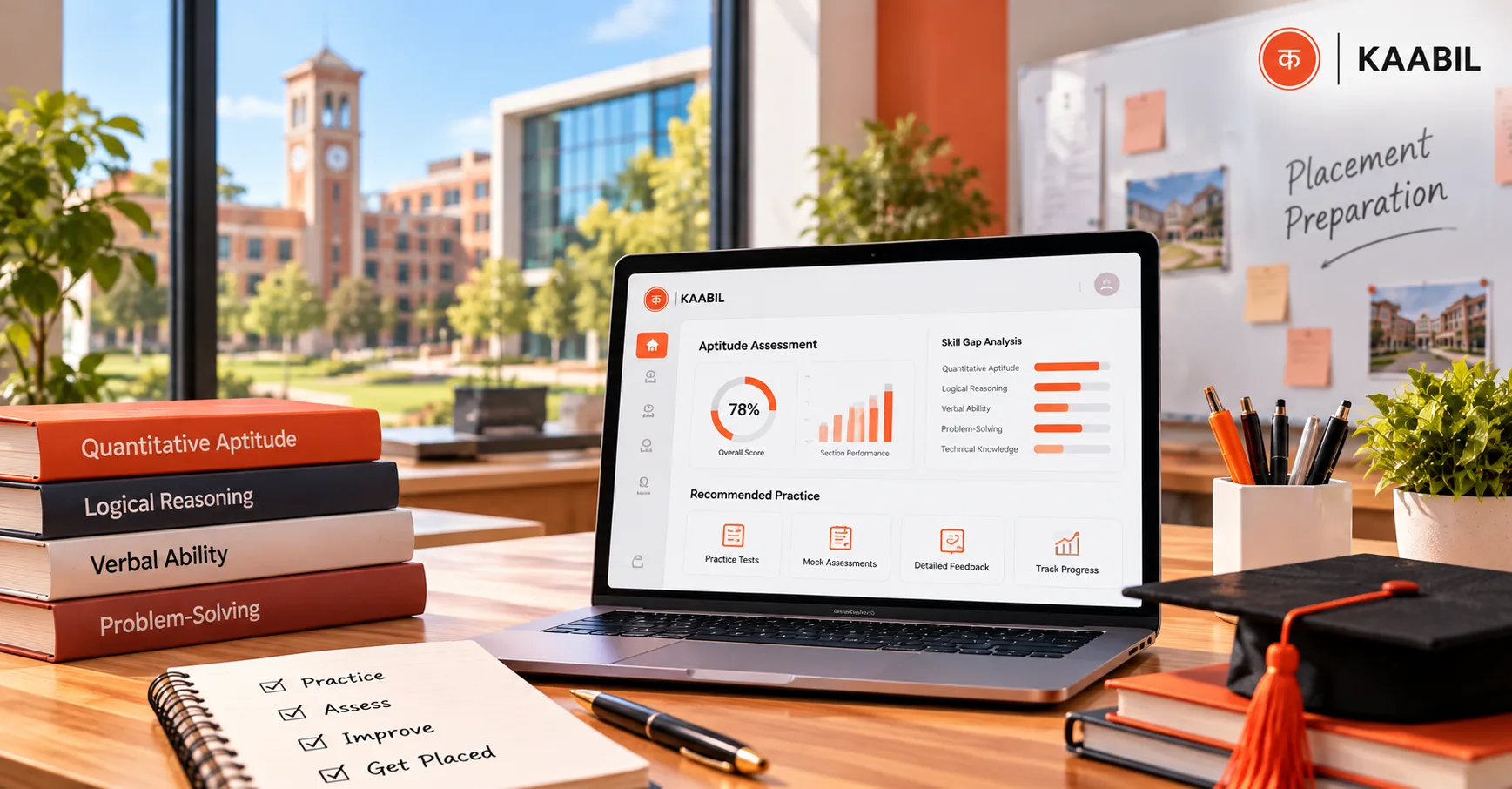
- Section-Wise Performance: Results can identify strengths and weaknesses across skill areas.
- Repeated Practice: Colleges can organize multiple assessment cycles.
- Consistent Assessment Structure: Standardized question patterns can support comparisons across students.
A free aptitude test may be useful for introducing students to common question formats.
However, generic tests may not reflect a college's curriculum, target industries or expected recruitment difficulty.
For more meaningful preparation, institutions should use assessments aligned with relevant skills and learning objectives.
How Kaabil Campus Helps Colleges Prepare Students for Placement Tests#
For colleges conducting regular aptitude and technical assessments, creating new papers and evaluating large numbers of responses can require substantial faculty effort.
Kaabil Campus is designed to simplify assessment creation, delivery and evaluation while keeping faculty in control of the content.
Unlike generic question banks, Kaabil Campus uses an institution's existing syllabus, curriculum or past papers as the starting point for generating assessments.
Key Capabilities of Kaabil Campus #
- Assessment Generation: Creates new question papers using institution-provided materials and existing assessment patterns.
- Faculty Control: Allows teachers to review and approve generated assessments before students attempt them.
- Pattern-Based Questions: Preserves the intended sections, marks and difficulty structure.
- Online Test Delivery: Enables learners to complete assessments through a web browser.
- Automated Grading: Evaluates submitted responses without requiring faculty to manually mark every paper.
- Section-Wise Feedback: Helps students identify stronger areas and topics requiring additional practice.
- Repeated Assessment Cycles: Supports generating fresh practice papers for ongoing preparation.
For example, faculty can use an existing aptitude paper to generate additional practice assessments with a similar structure.
Students can complete these assessments online, while section-wise feedback helps identify where further preparation is needed.
This makes Kaabil useful for institutions looking to conduct more frequent assessments without adding the same level of paper-setting and marking work.
For colleges, combining regular assessments with skill gap analysis can support more targeted placement preparation.
Make Every Assessment Count#
Final Thoughts#
Successful campus placement preparation requires more than conducting training sessions a few weeks before recruitment.
Colleges need a clear understanding of student capabilities, common weaknesses and the skills required for different job roles.
A structured aptitude test for placement can help identify gaps in numerical reasoning, logical reasoning, verbal ability and technical knowledge.
Regular online aptitude test cycles, mock assessments and section-wise feedback allow institutions to monitor progress rather than relying on one-time evaluations.
For Training and Placement Officers, combining assessment results with skill gap analysis makes it easier to prioritize training and support students who need additional preparation.
Kaabil Assess supports this process by helping institutions generate assessments from their own materials, evaluate responses and provide section-wise feedback.
Ultimately, the goal is not simply to help students score higher on tests. It is to identify weaknesses early, strengthen practical abilities and make placement preparation more effective.
Better Assessments. Stronger Placement Preparation
Frequently Asked Questions
An aptitude test for placement typically includes quantitative aptitude, logical reasoning, verbal ability and sometimes technical questions. The exact sections depend on the employer and job role.
Students should practise common placement aptitude questions, review weak areas and complete timed mock assessments. Regular practice and feedback can help improve accuracy and problem-solving speed.
Colleges can conduct an online aptitude test every two to four weeks during active preparation, with additional mock tests before recruitment drives. Frequency should depend on student needs and academic schedules.
Placement assessments commonly evaluate numerical ability, logical reasoning, verbal comprehension and domain knowledge. A broader employability test may also assess communication and other job-related capabilities.
Kaabil helps colleges generate assessments from their curriculum or past papers, conduct tests online and grade responses automatically. Section-wise feedback supports identifying areas requiring further practice.

Written by