Contents
- How do you find a job in India? 6 steps
- 1. Choose two or three target roles
- 2. Tailor your resume for each role
- 3. Use several channels at once
- 4. Prove your skills
- 5. Apply, follow up and track
- 6. Prepare for interviews
- How to get a job as a fresher?
- How to search jobs for freshers: where should you look?
- 1. Online Job Portals
- 2. Company Career Pages
- 3. College Placement Cells and Alumni Networks
- 4. Internships and Trainee Programs
- 5. AI-Powered Job Search Platforms
- 6. Referrals
- 7. Direct Messages to Recruiters
- How to get a job fast? Job search tips that help
- What does a weekly job search routine look like?
- How can an AI career agent help your job search?
- Frequently asked questions
Applying to more jobs does not always bring you closer to an interview. Sending the same resume to every opening, without checking what each role needs, mostly fills recruiters’ inboxes and leaves you waiting.
In a LinkedIn survey of 22,010 people across 17 countries, including India (January 2025), 37% of job seekers said they were applying to more jobs than ever but hearing back less. A plan works better than volume: fewer, better-matched applications through more than one channel.
This guide is the step-by-step version for freshers and job switchers in India: which roles to target, how to tailor your resume, where to look, how to follow up and how to keep a weekly routine.
How do you find a job in India? 6 steps#
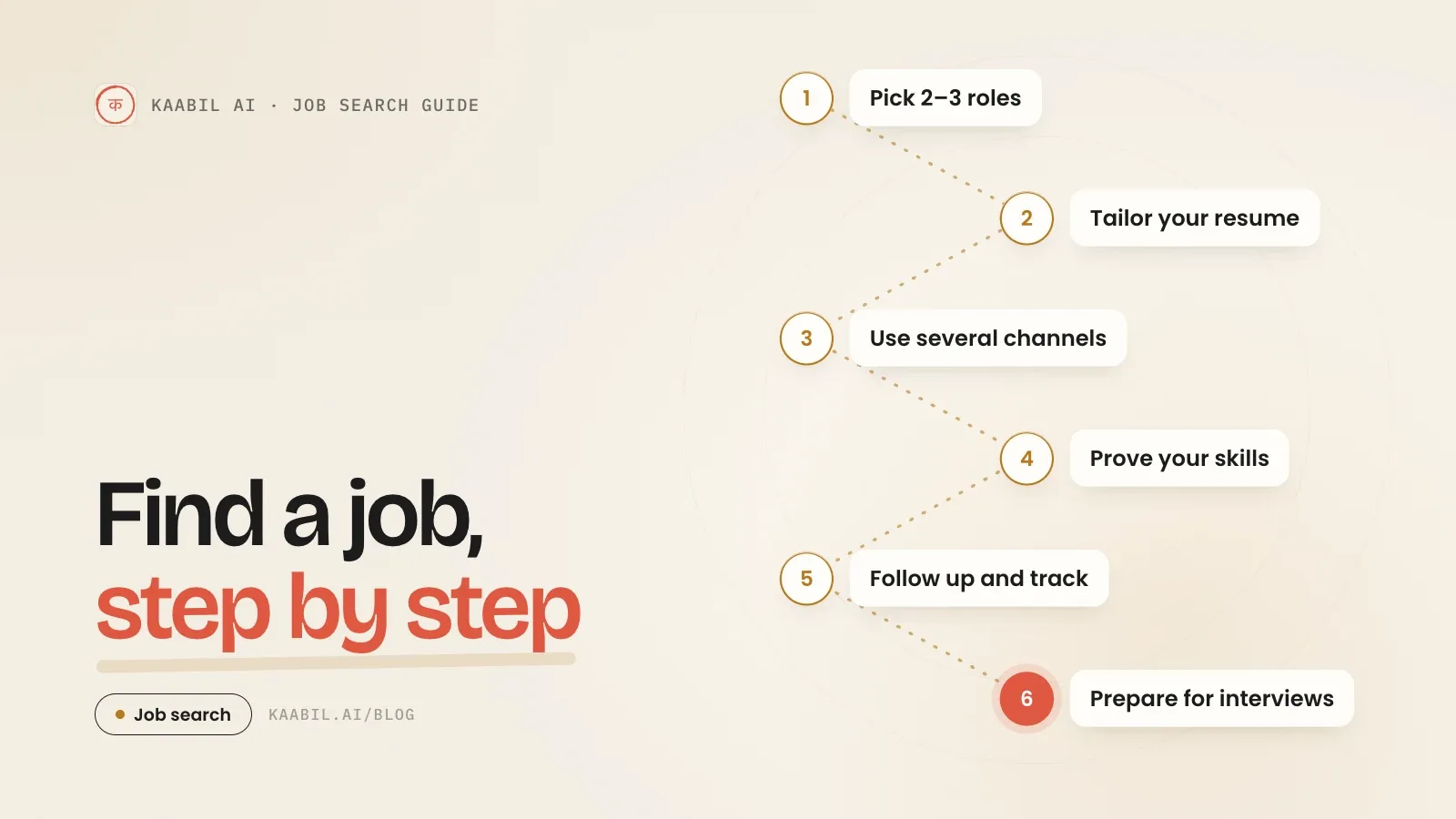
Six steps, in order. Each one makes the next easier.
1. Choose two or three target roles#
List the roles your degree, skills and interests point to, then pick two or three. A commerce graduate might choose Accounts Executive, Financial Analyst Trainee and Audit Associate; a marketing graduate might choose SEO Associate, Content Executive and Social Media Executive. Fewer roles means you can tailor properly.
2. Tailor your resume for each role#
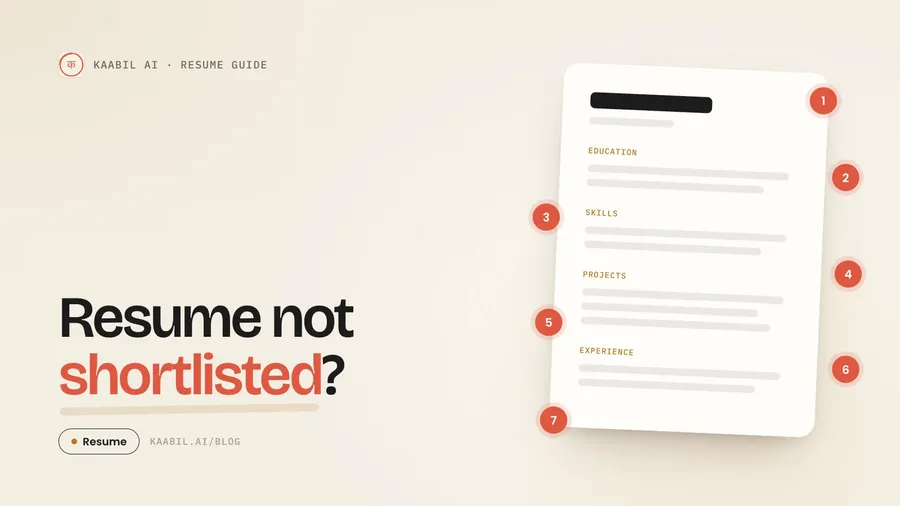
Keep one master resume, then adjust the summary, the order of skills and the top bullet points for each role, in the words the job description uses. Make your resume ATS friendly so the software can read it, and check the common reasons a resume is not getting shortlisted before you send it.
3. Use several channels at once#
Apply through company career pages, one or two job portals, your college placement cell and alumni, referrals, and direct messages to recruiters. Each channel reaches openings the others miss.
4. Prove your skills#
Recruiters look for evidence: a project you can explain, an internship with a result, a certificate or a skill assessment. Not sure which skills to show? Start with hard skills vs soft skills.
5. Apply, follow up and track#
Apply in the first few days after a job is posted. If you hear nothing after about a week, send a short follow-up to the recruiter or to the person who referred you. Track every application (company, role, date, channel, status and next step) so nothing slips.
6. Prepare for interviews#
Once calls start, prepare for each one: research the company, map your projects to the job description and practise short answers. Our job interview tips cover the rest.
How to get a job as a fresher?#
You have more routes than it seems. Use several at once:
- Campus placements: register with your placement cell early, check each company’s eligibility (many set a CGPA cut-off) and prepare for the aptitude round.
- Off-campus drives: large service companies run off-campus hiring for freshers; watch their career pages and apply as soon as a drive opens.
- Internships that convert: some internships lead to a full-time offer, so ask about conversion before you join.
- Trainee and graduate programmes: banks, retailers and manufacturers often hire freshers as trainees.
- Your first resume: one page, with education, skills, projects and internships first.
Without work experience, proof does the job: two or three projects, an internship, certificates or skill assessment results that match the role.
How to search jobs for freshers: where should you look?#
Finding suitable jobs for freshers can be challenging when many listings require experience or specific technical skills.
However, several channels can help candidates discover entry-level opportunities and build a more effective job search strategy.
1. Online Job Portals#
Job platforms provide opportunities across industries and experience levels. Candidates can apply for jobs online using filters for location, experience, salary range and employment type.
Job alerts can also help identify newly posted opportunities without repeatedly searching the same platforms.
2. Company Career Pages#
Many organizations publish openings directly on their official websites.Regularly checking the careers pages of preferred companies can help candidates find graduate programs, internships and entry-level positions.
Company websites are also useful for verifying job openings and understanding the recruitment process.
3. College Placement Cells and Alumni Networks#
College placement teams often connect students with recruiters hiring for entry-level roles. Alumni networks can also provide insights into companies, job openings and referral opportunities.
For freshers, these connections can make the transition from education to employment more manageable.
4. Internships and Trainee Programs#
Internships, apprenticeships and graduate trainee positions provide opportunities to gain practical experience.
Some programs may lead to full-time employment, although conversion is not guaranteed.
These positions are especially useful for candidates who want to build industry knowledge before applying for permanent roles.
5. AI-Powered Job Search Platforms#
Traditional job searches require candidates to move between multiple websites and manually compare openings.
AI job search platforms can simplify this process by recommending opportunities based on candidate profiles, preferences and relevant skills.
Some tools also support resume preparation, application tracking and repetitive job-search activities.
For freshers managing their first job search, this can reduce time spent switching between platforms.
6. Referrals#
A referral from someone inside the company gets your resume read by a person. Ask seniors, alumni and former colleagues; name the exact role, share the job link and attach your resume.
7. Direct Messages to Recruiters#
A short, specific message to the recruiter for a role (who you are, the role, two lines on why you fit) often gets a reply when a portal application doesn’t.
Watch out for fake job offers: never pay money to get a job, an interview or an offer letter. Real employers don’t charge candidates.
How to get a job fast? Job search tips that help#
There is no guaranteed shortcut, but these help:
- Widen your search: add an adjacent role or one more city.
- Apply early, in the first days after a job is posted.
- Ask for referrals instead of only applying on portals.
- Keep a ready-to-send resume and a short note for each target role.
- Follow up after about a week.
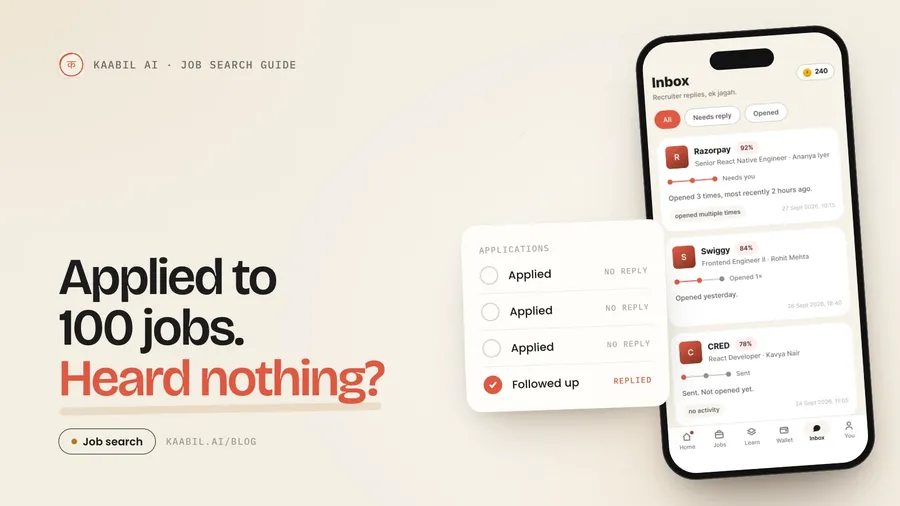
Sent many applications and heard nothing? Read what to do when you have applied to 100 jobs and heard nothing.
What does a weekly job search routine look like?#
A successful job search requires consistency, but that does not mean spending every available hour applying for jobs.
Following a weekly routine helps candidates balance applications, skill development and interview preparation.
Here is a practical schedule.
Day | Job Search Activity | Main Focus |
Monday | Research relevant openings | Identify suitable roles and companies |
Tuesday | Update resumes and apply | Submit focused applications |
Wednesday | Build skills and projects | Strengthen practical capabilities |
Thursday | Follow up and network | Connect with recruiters and professionals |
Friday | Practice interviews | Prepare answers and review job requirements |
Saturday | Review application progress | Track responses and improve strategy |
Sunday | Plan the upcoming week | Set realistic job-search goals |
This routine can be adjusted depending on available time, experience and career goals.
A fresher might spend more time developing practical skills, while an experienced professional may prioritize networking and targeted applications.
Using AI job search tools can also reduce repetitive tasks such as searching for matching opportunities and maintaining application records.
The most important factor is consistency.A smaller number of relevant, well-prepared applications can be more valuable than numerous unrelated submissions.
How can an AI career agent help your job search?#
It takes over the repetitive part of reaching recruiters, while you keep the decisions. This is how the Career Agent in Kaabil AI works:
- You set the roles, locations and work mode you want, and can exclude companies such as your current employer.
- It finds jobs that fit and contacts the relevant recruiters for you, from your own email.
- It sends only what you approve, and you review every step.
- Replies land in your inbox and show in the Kaabil App, so you can track outreach and replies in one view.
It does not apply to jobs for you: when a recruiter replies, you take it from there. Try it in the Kaabil App, or compare the Kaabil App plans.
Frequently asked questions
Show proof instead of experience: two or three projects, an internship, certificates or skill assessment results that match the role. Apply to trainee and entry-level roles, use your placement cell and alumni, and ask for referrals.
No single channel works for everyone. Combine company career pages, one or two job portals, your college network, referrals and direct messages to recruiters, and send a resume tailored to each role.
There is no magic number. A smaller set of well-matched, tailored applications with follow-ups tends to work better than mass-applying with the same resume.
An entry-level role open to candidates without full-time work experience, usually recent graduates. Job posts often say “0–1 years” or “freshers can apply”. Projects, internships and certificates count as proof for these roles.
Pehle 2–3 roles chuniye jo aapki skills se match karte hon. Har role ke liye resume thoda badaliye. Company career pages, job portals, college placement cell aur referrals, sab jagah apply kijiye. Ek hafte baad follow-up kijiye aur har application ka record rakhiye.
Kaabil AI’s Career Agent does not apply to jobs for you. It contacts relevant recruiters on your behalf and sends only what you approve, and you can track every reply in Kaabil App.
Sources
- More Applicants But Harder To Hire: Majority Of Job Applications Do Not Meet Listed Criteria, Finds LinkedIn, LinkedIn Pressroom (15 Jan 2025) · checked
- National Career Service portal, Ministry of Labour & Employment, Government of India · checked
- India's campus talent landscape pivots to skill-based hiring as 86 percent of employers adopt AI in recruitment (Campus Workforce Trends 2026), Deloitte India (27 Aug 2026) · checked
- Hiring benchmarks 2026: Recruiting metrics and trends, Greenhouse · checked