

On this page
- How Recruiters Decide Which Resumes to Shortlist
- 7 Reasons a Resume Is Not Getting Shortlisted (and How to Fix Them)
- 1. Using the Same Generic Resume for Every Job
- 2. Missing Important Skills from the Job Description
- 3. Listing Responsibilities Instead of Achievements
- 4. Using a Complicated Resume Format
- 5. Writing a Weak Professional Summary
- 6. Including Too Much Irrelevant Information
- 7. Applying for Jobs That Don't Match the Candidate's Profile
- Resume Summary and Objective Examples for Freshers
- 1. Resume Summary for Freshers
- 2. Resume Objective for Freshers
- Resume Summary vs. Resume Objective: Key Differences
- 60-Second Resume Checklist Before Applying
- When the Resume Isn't the Problem: Job Targeting and Proof of Skills
- How Kaabil Helps Improve Resume Shortlisting Readiness
- Final Thoughts
- Frequently asked questions
Sending out dozens of resumes but still not getting interview calls? The problem might not be the skills, but how the resume presents them.
For many job seekers, applying for jobs has become a routine of updating resumes, searching job portals and submitting applications. Yet, despite having relevant qualifications and experience, getting shortlisted remains a challenge.
This is especially frustrating for freshers looking for their first job and professionals planning their next career move.
When a resume is not getting shortlisted, the reason may be unclear formatting, missing job-related skills, a generic professional summary or a mismatch with the job requirements.
Recruiters often review hundreds of applications, making it important for a resume to communicate relevant qualifications and achievements clearly.
The good news? Small improvements in resume content, structure and job targeting can help make applications stronger and more relevant.
In this blog, we will explore seven common reasons a resume is not getting shortlisted, practical fixes, useful resume tips, examples for freshers and how Kaabil helps candidates build stronger resumes and discover relevant job opportunities.
How Recruiters Decide Which Resumes to Shortlist#
Recruiters often scan a resume before deciding whether to read it in detail. During this first review, they look for clear signs that the candidate meets the job requirements.
While review times vary, making key information easy to find can help with resume shortlisting.
Recruiters typically look for:
- Relevant skills: Skills and tools that match the job description.
- Experience and achievements: Work, internships or projects that show how those skills have been used.
- Education: Qualifications or certifications required for the role.
- Job fit: A background that suits the responsibilities and experience level.
- Clear formatting: Simple headings, readable text and well-organized sections.
For a resume for freshers, academic projects, internships and relevant certifications can help demonstrate potential when work experience is limited.
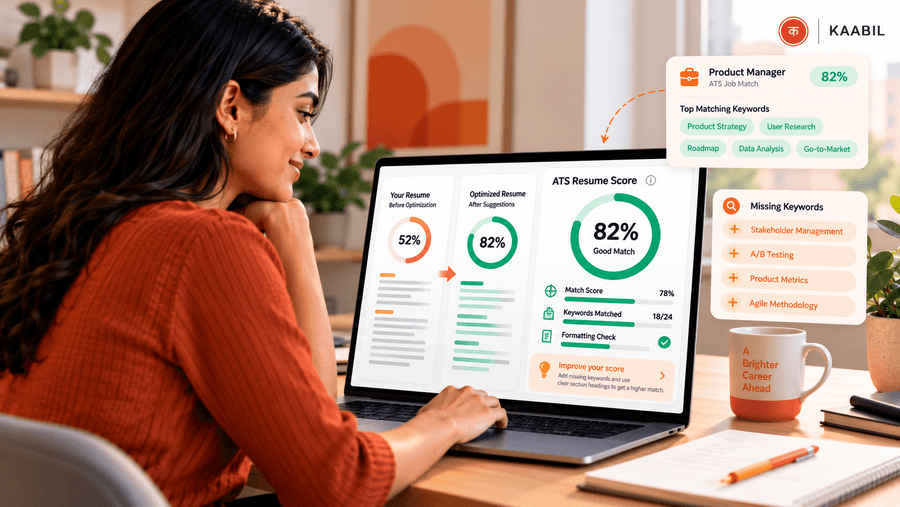
Some companies also use Applicant Tracking Systems to organize applications and help recruiters find relevant candidates. How these systems support screening varies by employer; keywords alone do not determine every decision.
One of the most useful resume tips is to make the match easy to see. Highlight relevant qualifications clearly and support skills with examples, so recruiters can quickly understand what makes the candidate suitable.
7 Reasons a Resume Is Not Getting Shortlisted (and How to Fix Them)#
Even qualified candidates may struggle to get interview calls because their resumes do not clearly communicate the skills and experience recruiters are looking for.
When a resume is not getting shortlisted, the issue could be related to its content, formatting or relevance to the job description.
Here are seven common reasons, along with practical fixes and examples to make resumes more effective.
1. Using the Same Generic Resume for Every Job#
The Problem:
A generic resume contains broad statements that could apply to almost any position. It does not clearly explain how the candidate's skills match a specific job.
For example, phrases like "hardworking professional" or "quick learner" provide little information about actual capabilities.
The Fix:
Customize the resume according to the target role. Highlight relevant qualifications, technical skills and experience that match the job requirements.
Before:
"Motivated graduate looking for a challenging position in a reputed organization."
After:
"Marketing graduate with knowledge of SEO, social media management and content creation, seeking an entry-level digital marketing role."
A role-specific resume helps recruiters understand the candidate's suitability for the position.
2. Missing Important Skills from the Job Description#
The Problem:
Sometimes, candidates have the required skills but do not mention them clearly in their resumes.
For example, a marketing candidate may have experience with Google Analytics or keyword research but only mention "digital marketing activities."
The Fix:
Review the job description and identify relevant tools, qualifications and skills. Include these naturally in the resume wherever they reflect actual experience.
Before:
"Worked on website performance and marketing activities."
After:
"Conducted SEO keyword research and monitored website performance using Google Analytics."
Clearly mentioning relevant skills makes it easier for recruiters to identify qualified candidates.
3. Listing Responsibilities Instead of Achievements#
The Problem:
Many resumes describe daily tasks without explaining the results achieved.
Statements such as "managed social media accounts" explain the responsibility but do not show the candidate's actual contribution.
The Fix:
Include measurable achievements, completed projects or specific improvements wherever accurate results are available.
Before:
"Managed social media accounts for the company."
After:
"Managed social media campaigns and increased engagement by 25% over six months." Adding achievements helps recruiters understand the impact of previous work.
Freshers can also highlight results from internships and academic projects.
4. Using a Complicated Resume Format#
The Problem:
Multiple columns, decorative graphics, inconsistent fonts and unnecessary design elements can make a resume difficult to read.
Some Applicant Tracking Systems may also struggle to extract information from complicated layouts.
The Fix:
Use a simple, single-column layout with clear section headings and consistent formatting.
An effective resume format for freshers should prioritize education, skills, projects, internships and certifications.
Before:
A resume with multiple sidebars, decorative icons and information scattered across different sections.
After:
A clean resume organized into Professional Summary, Education, Skills, Projects and Certifications.
A clear layout helps recruiters and recruitment software understand qualifications more easily.
5. Writing a Weak Professional Summary#
The Problem:
The professional summary is often one of the first sections recruiters review. A vague introduction may fail to communicate the candidate's qualifications and career interests.
This is especially common in a resume for freshers, where candidates may not have extensive work experience.
The Fix:
A strong resume summary for freshers should highlight educational qualifications, relevant technical skills and practical project experience.
Before:
"Looking for an opportunity to grow professionally and contribute to an organization."
After:
"Computer Science graduate skilled in Python, SQL and data analysis, with academic project experience in data visualization."
A focused professional summary quickly communicates the candidate's strengths and relevance to the role.
6. Including Too Much Irrelevant Information#
The Problem:
Adding unrelated skills, outdated achievements and unnecessary personal details can make a resume lengthy and difficult to scan.
When too much information is included, important qualifications may get overlooked.
The Fix:
Keep the resume focused on relevant skills, experience, achievements and certifications that support the job application.
Before:
A digital marketing resume containing unrelated school activities, outdated technical skills and a long list of hobbies.
After:
A focused resume highlighting SEO knowledge, content marketing projects, relevant internships and digital marketing certifications.
Removing unnecessary information helps recruiters focus on qualifications that matter.
7. Applying for Jobs That Don't Match the Candidate's Profile#
The Problem:
Sometimes, a resume may be well-written but still fail to get shortlisted because the candidate does not meet the job requirements.
For example, a fresher applying for a senior management position may not have the experience required for the role.
The Fix:
Target job opportunities that match existing skills, qualifications and experience levels.
Review job descriptions carefully before applying and prioritize positions with suitable eligibility requirements.
Before:
A recent marketing graduate applying randomly for entry-level, managerial and senior marketing positions.
After:
A marketing graduate applying for SEO Associate, Content Executive and Digital Marketing Trainee roles.
Applying for relevant positions improves job alignment and helps candidates focus on suitable career opportunities.
A strong resume is not just about good formatting or relevant keywords. It should clearly communicate genuine skills, achievements and suitability for the role.By avoiding these common mistakes, candidates can improve their resumes and make their applications more relevant to recruiters.
Resume Summary and Objective Examples for Freshers#
Creating a strong resume for freshers can be challenging when there is little or no professional experience.
However, freshers can highlight their education, technical skills, internships and academic projects to demonstrate their capabilities.
Two important sections that help introduce these qualifications are the resume summary and resume objective. Although they serve a similar purpose, they focus on different aspects of a candidate's profile.
1. Resume Summary for Freshers#
A resume summary for freshers is a short introduction that highlights a candidate's education, relevant skills and practical experience.
It helps recruiters quickly understand what the candidate knows and how those skills relate to the job.
Here are three examples for different career fields.
Example 1 - Digital Marketing Fresher
"Marketing graduate with knowledge of SEO, content creation and social media management. Completed academic projects involving keyword research and digital campaign planning."
Example 2 - Software Development Fresher
"Computer Science graduate skilled in Python, Java and SQL, with experience developing academic applications and working on collaborative coding projects."
Example 3 - Data Analyst Fresher
"Recent graduate with knowledge of Excel, SQL and Power BI, supported by academic projects involving data cleaning, visualization and reporting."
These examples show how freshers can highlight relevant skills and projects without claiming professional experience they do not have.
2. Resume Objective for Freshers#
A resume objective for freshers focuses on the type of job a candidate is seeking and how their existing skills can contribute to that role.
Unlike a resume summary, which highlights current qualifications, a resume objective emphasizes career direction and professional goals.
Here are three examples.
Example 1 - Digital Marketing Fresher
"Seeking an entry-level digital marketing role to apply knowledge of SEO, content marketing and campaign analysis while developing practical marketing skills."
Example 2 - Human Resources Fresher
"Seeking an entry-level HR position to apply communication, organizational and recruitment coordination skills while gaining practical experience in human resource management."
Example 3 - Software Development Fresher
"Seeking an entry-level software development role to apply programming knowledge, problem-solving skills and academic project experience."
Resume Summary vs. Resume Objective: Key Differences#
Resume Summary | Resume Objective |
Highlights existing skills and qualifications | Highlights career goals and desired roles |
Focuses on what the candidate can offer | Focuses on the career direction |
Useful when relevant projects or internships are available | Useful when entering the workforce or changing fields |
Emphasizes knowledge and practical experience | Emphasizes professional interests and relevant abilities |
A strong resume for freshers does not necessarily need both sections. Choosing the one that best represents the candidate's qualifications and career goals can keep the introduction clear and focused.
The key is to keep the summary or objective short, relevant to the job description and supported by genuine skills and qualifications.
60-Second Resume Checklist Before Applying#
Before submitting a job application, reviewing the resume one final time can help identify small mistakes that may affect resume shortlisting.
A quick check ensures that the resume is accurate, easy to read and relevant to the position.
Here are seven important things to review before applying:
- Job Relevance: The resume highlights skills and qualifications that match the target role.
- Relevant Keywords: Important skills and keywords from the job description are included naturally.
- Professional Summary: The introduction clearly communicates relevant qualifications and career interests.
- Achievements and Projects: Work experience, internships or academic projects demonstrate actual contributions.
- Resume Formatting: The layout is simple, consistent and easy for recruiters to read.
- Contact Information: Email address, phone number, employment dates and other important details are accurate.
- File Format: The resume is saved in the format requested by the employer, usually PDF or DOCX.
Following these resume tips can help candidates avoid common mistakes and submit stronger, more relevant applications.
A final review takes only a minute but can help prevent important qualifications from being overlooked.
When the Resume Isn't the Problem: Job Targeting and Proof of Skills#
Sometimes, even a well-written resume may not lead to interview calls. The reason may not be poor formatting or missing keywords, but applying for unsuitable roles or failing to demonstrate practical skills.
For example, two candidates may list Excel, SQL and Power BI on their resumes. However, a candidate with relevant projects or practical experience may be able to demonstrate those skills more clearly.
This is why improving resume shortlisting readiness involves more than creating a professional document.
A stronger job application strategy should focus on four important areas:
- Relevant Job Applications: Apply for positions that match existing skills, qualifications and experience levels.
- Proof of Skills: Highlight projects, internships, certifications and assessments that demonstrate practical capabilities.
- Clear Resume Content: Present relevant achievements, responsibilities and qualifications in a structured format.
- Application Tracking: Monitor submitted applications, recruiter responses and follow-up opportunities.
Combining these practices can help candidates identify suitable opportunities and present their abilities more effectively.
The goal is not simply to apply for more jobs, but to make genuine skills and experience easier for recruiters to recognize.
How Kaabil Helps Improve Resume Shortlisting Readiness#
A strong job application requires more than a well-formatted resume. Candidates also need to highlight relevant skills, demonstrate practical abilities and identify opportunities that match their qualifications.
Kaabil simplifies this process by bringing together AI-powered resume tools, skill assessments and relevant job opportunities in one platform.
From improving resume quality to discovering suitable roles, Kaabil helps candidates approach their job search with greater clarity and confidence.
Its key capabilities include:
- AI Resume Builder: Helps candidates create professional, structured resumes that highlight relevant skills, qualifications and experience.
- Resume Evaluation: Identifies areas where resume content, formatting and job relevance can be improved.
- Skill Assessments: Helps candidates demonstrate practical skills and capabilities beyond their resumes.
- Job Matching: Connects candidates with relevant opportunities based on their skills, experience and career interests.
- AI Career Agent: Designed to simplify job searching, prepare applications, support recruiter outreach and track application progress.
For freshers and experienced professionals, Kaabil combines resume improvements with skill-based evaluation and relevant job opportunities to make the application process more focused.
The goal is to help candidates showcase their real capabilities and move closer to suitable career opportunities.
Final Thoughts#
Getting shortlisted for a job depends on several factors, including resume clarity, relevant qualifications, work experience and alignment with the job requirements.
A strong resume should communicate these details clearly without exaggerating achievements or adding unnecessary keywords.
Simple improvements, such as highlighting relevant skills, including measurable achievements and following a clean resume structure, can make applications more effective.
For freshers, choosing the right resume format for freshers and writing a clear resume summary for freshers can help demonstrate potential even without extensive work experience.
However, a well-written resume is only one part of the process. Applying for suitable roles and demonstrating practical skills through projects, internships and assessments are equally important.
Kaabil supports this journey by helping candidates improve their resumes, validate their skills and discover relevant job opportunities.
Ultimately, a successful job application is not just about getting noticed. It is about presenting genuine capabilities and showing recruiters why a candidate is suitable for the role.
Frequently asked questions
1. Why is my resume not getting shortlisted?
If a resume is not getting shortlisted, possible reasons include missing relevant skills, poor formatting, generic summaries or applying for unsuitable roles. Improving resume content and targeting relevant jobs can increase shortlisting chances.
2. How do recruiters shortlist resumes?
Recruiters review skills, qualifications, experience and job relevance. Many companies also use Applicant Tracking Systems (ATS) to organize applications and support resume shortlisting.
3. What should a fresher write in a resume summary?
A resume summary for freshers should highlight education, relevant skills, internships and academic projects. It should clearly communicate qualifications and suitability for the target role.
4. How long should a fresher resume be?
A resume for freshers should ideally be one page. A clear resume format for freshers should focus on education, skills, projects, internships and relevant certifications.
5. How does Kaabil help improve resume shortlisting chances?
Kaabil helps candidates build and evaluate resumes, highlight relevant skills and discover matching jobs. Its skill assessments and AI Career Agent also support career readiness and job searching.

Written by
Garima Lakhani
Sr. Digital Marketing Specialist